Some weeks disappear into a vague feeling: busy, fine, tiring. A wellness journal on your iPad can hold the small details that get lost in that summary. My favorite starting point is one question repeated for seven days, followed by a quiet look back at what you actually wrote.
These twenty wellness journal ideas are alternatives, not twenty tasks for tonight. Choose one for a week, keep the response short and use the same wording each time. Below, I have picked eleven digital journals and planners with different amounts of structure, from a daily reflection box to space for your own notes.
What belongs in a wellness journal notebook?
Think of this as a personal record of your days: a feeling, a moment, the circumstances around it and something you want to remember. It can include rest, sleep, gratitude, attention or a habit you are curious about. You do not need to turn every part of your health into a measurement.
A diary can tell the whole story; a structured journal asks a narrower question. Blank journals give you space to create that structure, while a dedicated journal can supply a starting prompt. For this exercise, use the narrower version so that Sunday’s answer still has something in common with Monday’s. Your journaling practice can use brief daily check-ins: “I felt rushed after three back-to-back calls” says more than “bad day.”
- One question: write it at the top of the week and leave it unchanged until the review.
- One dated response: a sentence or two about what happened, with an optional mood word.
- One context note: an unusual deadline, a visitor or a disrupted routine, when relevant.
- One review space: save room for repeated details, exceptions and a modest next step.
If your goal is a colorful record of feelings rather than a repeated writing question, the mood tracker ideas offer a different starting point. Here, the sentence and its context do the main work; a color is only an optional shorthand.
If you are new to journaling, use this as a quick way to collect details you want to reflect on later. Wellness journals can hold a gratitude journal entry, a practical concern or an ordinary observation; your journaling habit does not need to focus on feeling positive. Choose the question that matters to you, rather than treating the page as a checklist for everyone.
Eleven iPad tools with room for your own answers
I prioritized visible writing space, clear navigation and a useful connection to reflection. A dedicated daily journal gives you a ready-made rhythm; a broader planner lets the note sit beside the day’s schedule. The prompts later in this article are my suggestions for using that space, not a claim that each product already contains those exact questions.
TL;DR: Choose one question, answer it briefly for seven days and reread the entries together. Look for repeated details, keep exceptions visible and choose one small adjustment. The eleven tools below range from dedicated daily reflection to broader planners with writing space.
Quick Picks
- Best for repeating the same daily page: Digital Wellness Journal
- Best for writing beyond a rating: Positive Mind Journal/Digital Journal
- Best for a small starting file: Self Care Journal, Digital Journal, PDF
- Best for a monthly perspective: The Ultimate Selfcare Planner | Planner
- Best for notes beside the day’s plans: Digital Planner Cute Pastel ( Undated )
- Best for a tracker plus written context: All in One Digital Planner Undated V2.3
- Digital Wellness Journal – Best for repeating the same daily page
- Positive Mind Journal/Digital Journal – Best for writing beyond a rating
- Self Care Journal, Digital Journal, PDF – Best for a small starting file
- The Ultimate Selfcare Planner | Planner – Best for a monthly perspective
- Digital Planner Cute Pastel ( Undated ) – Best for notes beside the day’s plans
- All in One Digital Planner Undated V2.3 – Best for a tracker plus written context
- Undated Digital Planner for Goodnotes – Best for a decorated notes page
- ADHD Life Planner for Goodnotes – Best for a separate notebook section
- ADHD Digital Planner | GoodNotes – Best for a weekly review in a compact planner
- All-in-One Digital Planner, GoodNotes – Best for landscape planning and reflection
- Essential Digital Planner, Goodnotes – Best for portrait planning and reflection
Dedicated journals for daily answers
Best for repeating the same daily page
1. Digital Wellness Journal
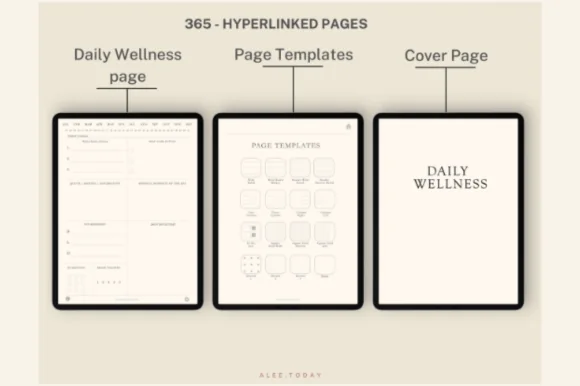
Layouts: 365 daily pages; 16 templatesDates: Undated
Best for: minimalists, daily check-in fans, wellness planners. Designed by ThePlannersDelight.
- 365 undated daily wellness pages with hyperlinks; PDF journal
- 16 page templates, including ruled, dotted, columns and blank pages
- Five matching covers and 100+ pre-cropped botanical PNG stickers
- Seller specifies a tablet you can write on with a stylus, such as Apple Pencil; apps, tablet and stylus are not included
The daily reflection box gives the week a consistent anchor. Put the same question there each evening and use a column template for the weekly look back. The goals and self-care fields can stay empty when they are beside the point; filling every box is not the assignment. Choose this ivory version for the lighter page design.

Best for writing beyond a rating
2. Positive Mind Journal/Digital Journal
Layouts: 20 pages including reflection, mindfulness and notes
Best for: beginners, pink lovers, evening journalers. Designed by Nann Digital Art.
- 20 pages with hyperlinked tabs and an index
- Daily Mindfulness, Evening Reflection, Spilled Mind and Mind Map pages
- Notes, quotes, extra pages and sticker pages
- US Letter layout; GoodNotes, Notability, Noteshelf and Xodo listed
This is my pick for a week built around an evening question. The lined reflection page has room for a few sentences, while Spilled Mind can hold the longer story you do not want to squeeze into a daily box. Write your chosen question as an annotation rather than assuming its wording is already printed in the journal.

Best for a small starting file
3. Self Care Journal, Digital Journal, PDF
Format: PDF; fixed design
Best for: beginners, self-care fans, pink lovers. Designed by bellaROSEworkshop.
- Six journal pages, excluding the cover
- PDF pages for digital use; Notability named by the seller
- Prompted writing areas and a notes page shown
- Fixed page design, not an editable template; personal use only
The small page set makes the starting choice manageable. Use its questions when they match your weekly theme, or put your own response on the notes page. Because the underlying design is not editable, choose another option if rearranging printed fields is essential. Writing over a page in an annotation app is different from editing its original layout.
Undated planners with room to write
Best for a monthly perspective
4. The Ultimate Selfcare Planner | Planner
Layouts: Monthly calendar, goals and reflectionDates: UndatedWeek start: Monday
Best for: self-care planners, positive mindset fans. Designed by yarasdigitalshop.
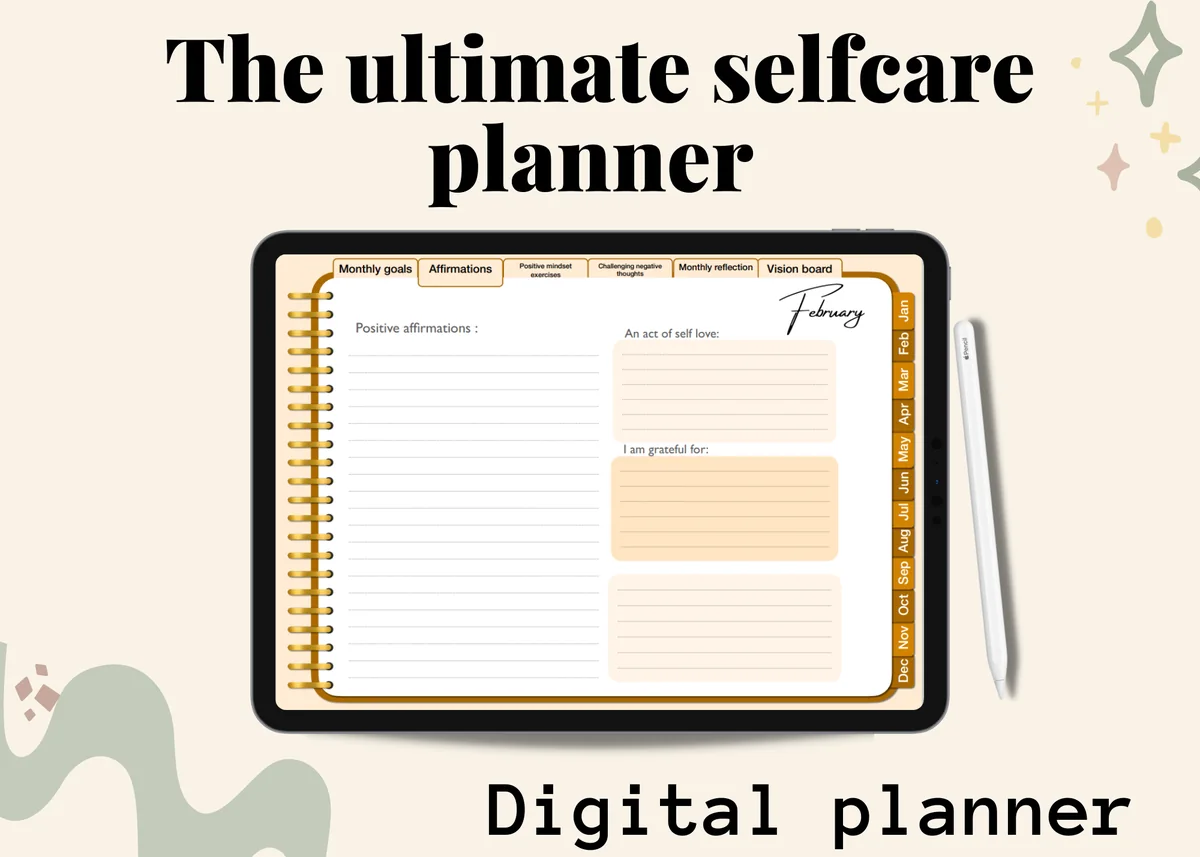
- 12 undated monthly calendars with a Monday start
- Monthly goals, affirmations and monthly reflection
- Positive mindset exercises, thought-writing pages and a vision board
- 18 hyperlinks per page; GoodNotes and Notability listed
This is a monthly planner rather than a ready-made seven-day log. Its monthly reflection is useful as a place to collect the conclusions from your weekly notes. Keep the daily experiment on a separate writing page if you need more space. The thought exercises are optional writing prompts, not a promise of a mental-health result.
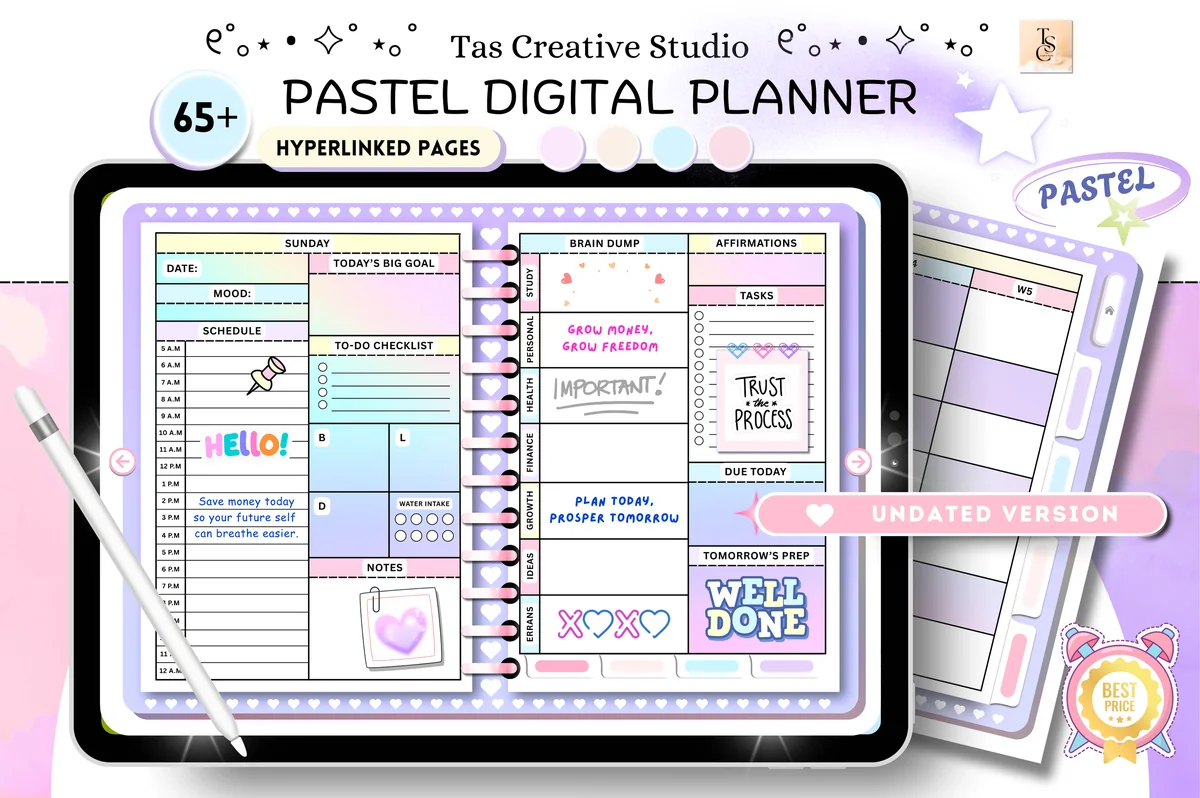
Best for notes beside the day’s plans
5. Digital Planner Cute Pastel ( Undated )
Orientation: Landscape, 11 × 8.3 inchesLayouts: 68 pages; daily, weekly, monthly and trackersDates: UndatedWeek start: Sunday shown
Best for: pastel lovers, wellness planners, challenge fans. Designed by Tas Creative Studio.
- 68-page hyperlinked landscape planner, 11 × 8.3 inches
- Daily and weekly planning, a weekly self-care checklist and daily routines
- Daily page preview shows mood, brain dump and notes fields
- GoodNotes, Notability, Noteshelf and Xodo listed
The brain-dump and notes spaces let an observation sit beside the actual schedule. That context matters when a Tuesday felt different because it was unusually busy. Use one notes field for the repeated question and leave the health challenges out of this exercise. The pastel design is busier than the ivory journal, so choose it for that visual style rather than expecting a blank notebook.

Best for a tracker plus written context
6. All in One Digital Planner Undated V2.3
Layouts: 900 pages; planning, trackers and notesDates: UndatedWeek start: Sunday and Monday shown
Best for: fitness fans, wellness planners, pink lovers. Designed by CraftAddicted.
- 900 hyperlinked pages for fitness, wellness, nutrition and general planning
- Mood tracker, monthly sleep tracker and monthly habit tracker
- Notes templates and ten notebook sections shown in the gallery
- GoodNotes and Notability listed; purchase includes a PDF with Google Drive file links
The separate trackers and notebook sections offer ample room for written context. Use a notes page for the question and only one relevant tracker for context; the rest can wait. A sleep entry beside a mood entry records what happened together, not why. File access is through links in the received PDF, so allow an extra step before importing the planner into your annotation app.
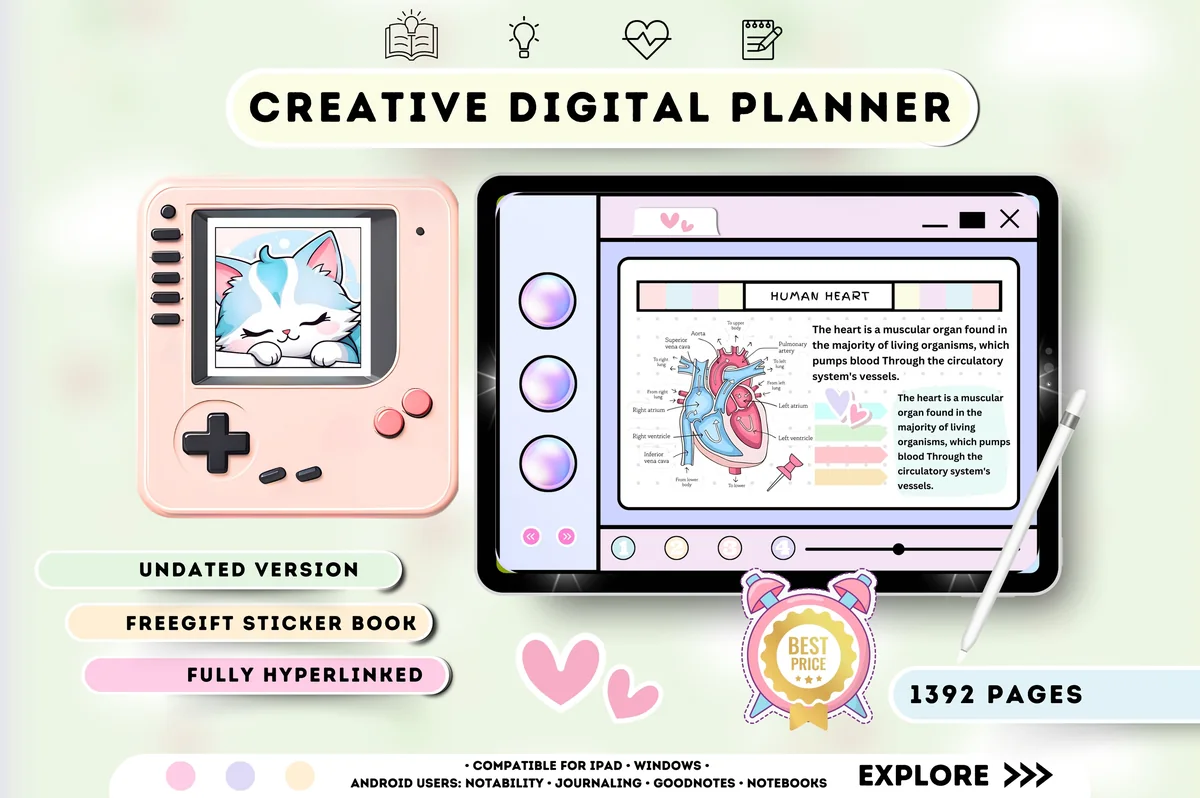
Best for a decorated notes page
7. Undated Digital Planner for Goodnotes
Orientation: Landscape, 11 × 8.3 inchesLayouts: Daily, weekly, monthly and dotted notesDates: Undated
Best for: writing your own reflection inside a broader planner. Designed by Tas Creative Studio.
- Undated landscape planner with individual 12-month modules
- Daily, weekly and monthly hyperlinked navigation
- Dotted note-taking layouts shown; five-page sticker book included
- GoodNotes, Notability, Noteshelf and Xodo listed
The dotted note-taking page suits a weekly layout you want to draw yourself. Draw seven small response spaces and keep the artwork outside those boxes. It is a broad planner, so you are making the reflection layout yourself. The game-style decoration gives it a playful appearance; it is a visual preference, not a different journaling method.
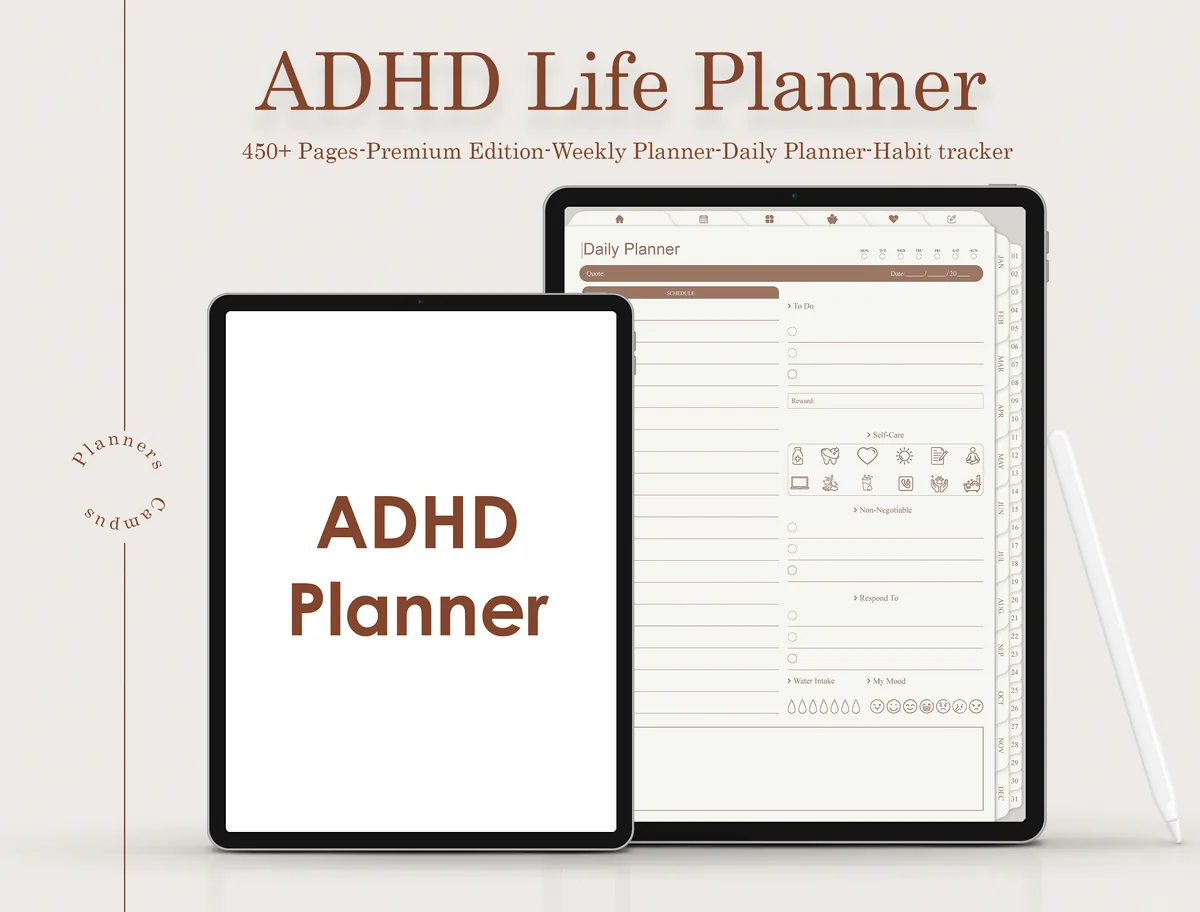
Best for a separate notebook section
8. ADHD Life Planner for Goodnotes
Layouts: Planning, wellness and notebook sections
Best for: ADHD brains, life trackers, self-care routines. Designed by Planners Campus.
- Planner for Goodnotes with goals, planning, wellness and notes sections
- Gallery shows a notebook with lined, dotted and right-line layouts
- Monthly review and self-care navigation shown in the index
The notebook section offers a clear home for the repeated-question exercise, away from the day’s task list. Begin with the lined page and leave the broader tracker collection alone until there is a reason to use it. Despite the product name, I am selecting writing space here, not recommending a treatment or an ADHD management program.
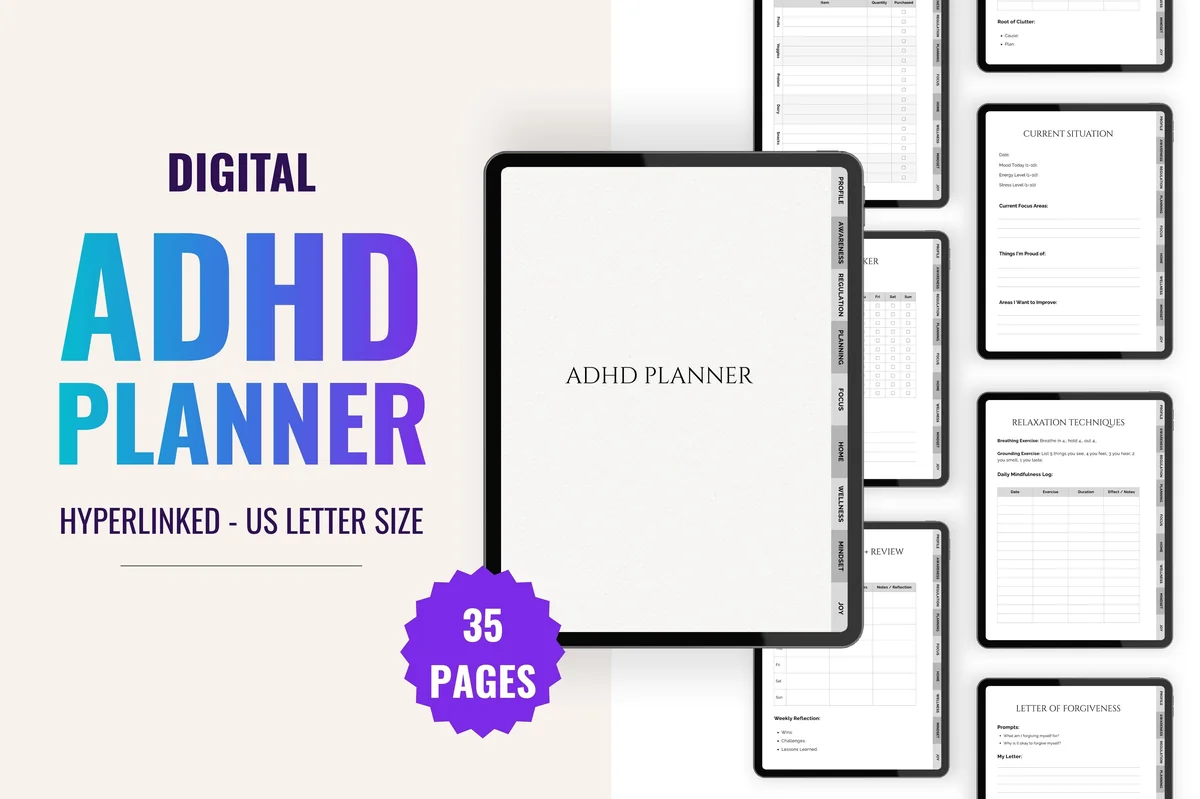
Best for a weekly review in a compact planner
9. ADHD Digital Planner | GoodNotes
Layouts: Weekly review, daily planning and journal notes
Best for: ADHD planners, busy households, weekly resetters. Designed by Toon Forest.
- 35-page digital planner for GoodNotes
- Weekly planner and review, daily planner and activity pages
- Journal section with notes; brain dump and thoughts tracker listed
- US Letter size and hyperlinked navigation shown
The weekly review is a useful destination for a summary of your seven entries. Keep the daily answers in notes and bring across only the details you still want to consider. This has more structure than a blank journal, but a much smaller listed page count than the large all-in-one options. Its condition-specific exercises are separate from the personal writing approach in this article.
Dated planners for calendar context
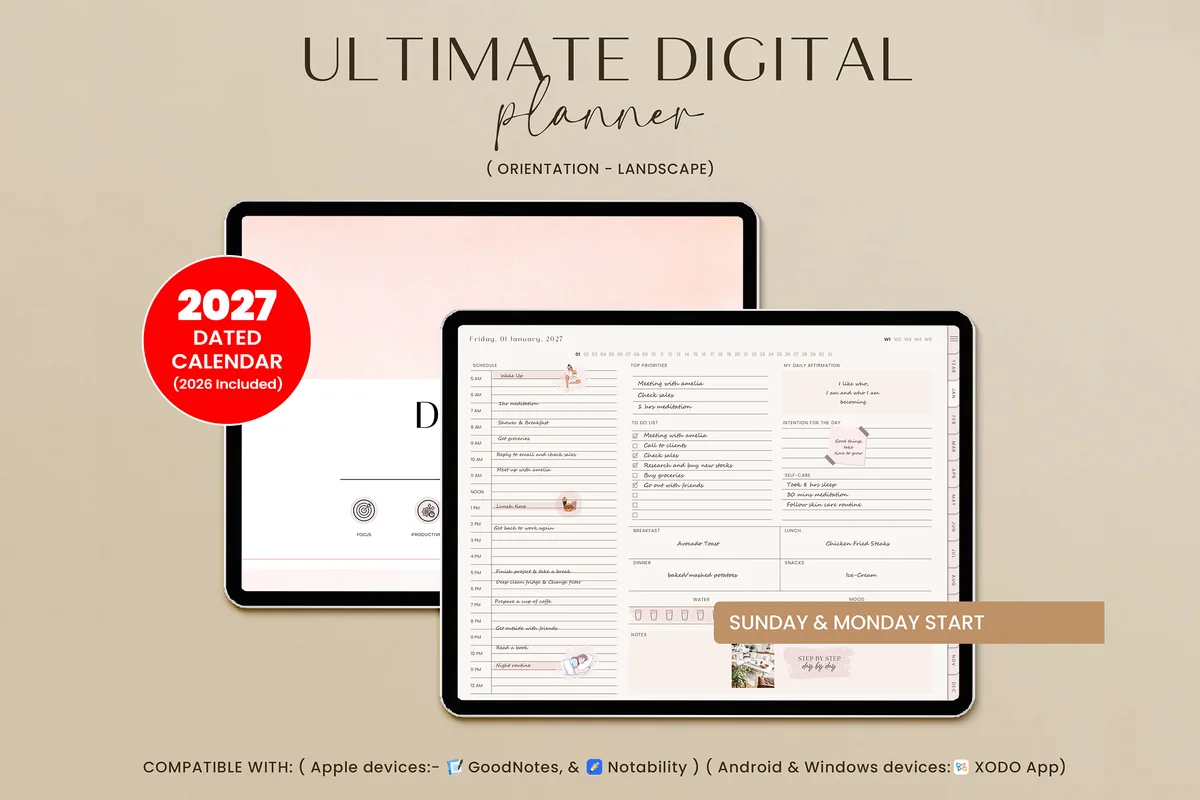
Best for landscape planning and reflection
10. All-in-One Digital Planner, GoodNotes
Orientation: LandscapeLayouts: 600 pages; planning, trackers and notesDates: 2027 calendar; 2026 also includedWeek start: Sunday and Monday
Best for: keeping review notes beside a dated calendar. Designed by TrendyCreative.
- 600-page landscape planner with daily, weekly and monthly pages
- Monthly reflection, sleep and mood trackers
- Five custom note sections and six note-paper types
- Gallery shows a dated 2027 calendar with 2026 included; Sunday and Monday starts
This is a calendar-led choice for someone who wants the observation beside the rest of life planning. Use a custom notebook section for the week, then consult the calendar for context. It is dated, so check that the included year fits your plans. The landscape spread is the main difference from the portrait Essential planner below, rather than a different reflection method.
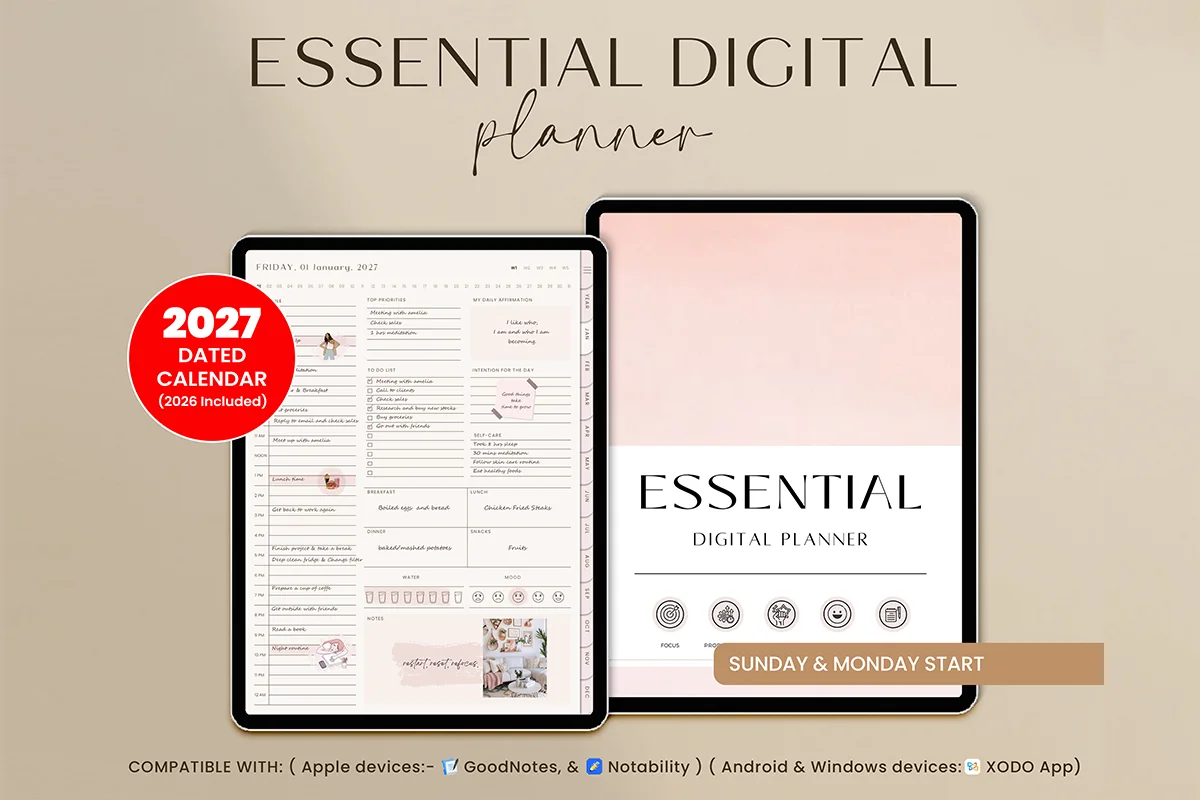
Best for portrait planning and reflection
11. Essential Digital Planner, Goodnotes
Orientation: PortraitLayouts: 563 pages; planning, wellness and notesDates: 2027 calendar; 2026 also includedWeek start: Sunday and Monday
Best for: keeping a week of writing in a narrower page layout. Designed by TrendyCreative.
- 563-page portrait planner with daily, weekly and monthly pages
- Monthly reflection, sleep and mood trackers
- Five custom note sections and six note-paper templates
- Gallery shows a dated 2027 calendar with 2026 included; Sunday and Monday starts
Choose the portrait layout if a tall page suits the way you write. Its custom notes give the weekly exercise a place without asking you to use every lifestyle section. Compare the visible writing area with the landscape alternative before buying; both have the calendar context, while the arrangement of the page is different.
Quick Comparison
| Tool | Choose for | Writing space | Type |
|---|---|---|---|
| 1. Digital Wellness Journal | Daily repetition | Daily reflection and note templates | Undated PDF |
| 2. Positive Mind Journal/Digital Journal | Evening context | Reflection, mind map and notes | Digital journal |
| 3. Self Care Journal, Digital Journal, PDF | Small prompted set | Reflection questions and notes | Six-page PDF |
| 4. The Ultimate Selfcare Planner | Planner | Longer perspective | Monthly goals and reflection | Undated digital planner |
| 5. Digital Planner Cute Pastel ( Undated ) | Schedule context | Daily mood, brain dump and notes | Undated digital planner |
| 6. All in One Digital Planner Undated V2.3 | Tracker with context | Mood, sleep and notebook sections | Undated digital planner |
| 7. Undated Digital Planner for Goodnotes | Custom notes layout | Dotted writing space and monthly modules | Undated digital planner |
| 8. ADHD Life Planner for Goodnotes | Separate notebook | Lined and dotted notebook pages | Digital planner |
| 9. ADHD Digital Planner | GoodNotes | Compact review system | Notes, brain dump and weekly review | Digital planner |
| 10. All-in-One Digital Planner, GoodNotes | Landscape calendar context | Custom notes and monthly reflection | Dated digital planner |
| 11. Essential Digital Planner, Goodnotes | Portrait calendar context | Custom notes and monthly reflection | Dated digital planner |
20 wellness journal prompts: choose one for the whole week
The best question is the one you can answer honestly on an unremarkable day. Pick a theme below, then use just one prompt for seven entries. A neutral answer counts; you do not need to manufacture gratitude or a breakthrough to keep a journaling habit.
Notice the texture of the day
- 1What moment slowed me down? Name one moment when the pace changed, even briefly. Write where you were and what was happening. On review day, compare the circumstances rather than deciding that one activity must work every time.
- 2When did I feel most present? Choose a particular scene instead of rating your whole day. “Listening to a friend at lunch” is enough. If nothing stands out, write that plainly and keep the entry; it is still part of the week.
- 3What kept returning to my attention? Record a thought, task or interruption in a few words, then add whether you chose to return to it. When the seven days are over, separate recurring interests from unfinished practical tasks you may want to put elsewhere.
- 4What did I notice outside my screen? Use one sensory detail: a sound, a color, the weather or the feeling of a chair in the sun. Keep it observational. This gives the review something concrete without asking you to judge whether the day was productive.
- 5What surprised me about today? Capture a small mismatch between expectation and experience. Perhaps a meeting was easier than expected, or a quiet afternoon felt restless. Keep both the expectation and what happened so the later entry does not erase the earlier one.
Put feelings beside their context
- 6What word fits my evening? Use a word that makes sense to you, followed by one event from the day. “Mixed” is a valid answer. If you use colors too, keep their meaning consistent for the week so the shorthand remains readable.
- 7When did my energy feel different? Describe a time and situation in your own words. You can mention how you remember sleeping, but avoid converting two observations into an explanation. “Tired after a crowded commute” leaves more room for uncertainty than a rule about all commutes.
- 8What was taking up mental space? List one concern, then note whether it needed action or simply needed somewhere to be written. Keep longer brain dumps on another page. The repeated entry can point to that page without copying the whole story into the weekly record.
- 9What made the day feel crowded? Choose one concrete pressure: too many tabs, a noisy room, a deadline or too little transition time. Note an exception when the same thing did not bother you. Those exceptions belong in the review alongside the more obvious repetitions.
- 10What part of today is still unclear? Leave a place for uncertainty rather than forcing a positive interpretation. You might write, “I cannot tell why the evening felt difficult.” When you reread it, do not replace that honest uncertainty with a tidy story you could not support at the time.
Recognize support without forcing positivity
- 11What small thing felt supportive? Name an action, object or person and the specific moment involved. “A friend checked in after my presentation” is more useful to revisit than “friends.” You are collecting personal examples, not assigning responsibility for your wellbeing to someone else.
- 12What am I glad I noticed? Try gratitude as attention rather than a demand to feel cheerful. Keep the detail small and varied. If the day was hard, appreciation and difficulty can appear in the same answer without either one cancelling the other.
- 13What did I allow to be enough? Record something you stopped at a reasonable point: a short walk, a simple meal or one finished task. Explain what “enough” meant that day. The point is to remember your decision, not create a new standard you must meet tomorrow.
- 14Which boundary mattered today? Write one choice about time, availability or attention. Include the situation and what you chose, without grading the boundary as a success or failure. During the review, ask whether the choice still fits rather than assuming a firmer boundary is always better.
- 15What would I like to remember from a conversation? Keep one phrase or your own summary of an exchange that mattered. Avoid unnecessary identifying details about another person. At the weekly review, consider what you want to carry forward in your own behavior, rather than analyzing the other person.
Turn a look back into a small next step
- 16What helped me return after an interruption? Describe one return to a task, a break or the journal itself. It might have been a reminder, a clear next step or permission to stop. Look for usable examples without treating the week as a test of self-discipline.
- 17What did I choose to leave unfinished? Name an unfinished item and why you left it. Some entries may be deliberate choices and others may be things that slipped. Keeping that distinction visible can make the weekly review more honest than a single list of everything you did not complete.
- 18What would make tomorrow a little simpler? Write one practical suggestion, such as putting a charger near your chair or leaving a note for the morning. During the week, record the suggestion without adding five more tasks. Later, choose only one you still want to try.
- 19What changed from my first impression? Return to a moment from earlier in the day and note whether you see it differently now. Both versions deserve space. On review day, look for changes in perspective without assuming the latest interpretation is the final or correct one.
- 20What question would I carry into next week? Write a question rather than a promise: “Would a quieter transition after work suit me?” works better here than a strict new routine. At the review, choose whether to keep, change or drop it based on your interest and available attention.
Set up a wellness journal template for seven comparable notes
Start with a blank, lined or dotted writing page, or the reflection area of your chosen journal. A notebook layout needs only a date, the repeated question and response space. You can keep the same structure on paper, but on iPad I would keep the week together so it is easy to reread.
A simple setup sequence
- 1Choose the question before decorating. Write why you are interested in it in one sentence. For example: “I want to remember what the transition after work actually felt like.” Keep the scope small enough that a normal day supplies an answer.
- 2Make seven dated spaces and a review area. Use one page per day if you like writing freely, or divide a notes page into short sections. Add the dates yourself on undated pages. The seven-day structure is something you create; it is not a promised template in each product.
- 3Choose a realistic stopping point. Try two sentences or a few minutes, whichever feels easier to keep. Put any longer story on a linked or neighboring notes page. A short entry can stand on its own without being expanded into an essay.
- 4Decide what to omit. Leave out any metric that makes the practice feel like surveillance. You can write about rest without counting hours and about nourishment without logging food. Use only fields that serve the question you actually chose.
- 5Put the review date somewhere visible. Choose a day you can return to the notes, rather than treating midnight on Sunday as a deadline. If you miss entries, review the ones you have and mark the gaps; do not reconstruct missing days as though you had recorded them.
If you keep a bullet journal on your iPad, give the repeated question a small space beside each day’s notes. A key can distinguish the original entry from a comment you add during the review. Keep the symbols simple so you spend your attention on the writing rather than getting the notation right.
For a mindful gratitude entry, name one thing you felt grateful for and describe when you noticed it. You might explore why a quiet lunch mattered without making a big claim about the whole day. If you’re working towards a more focused evening routine, use the same question about that transition for the week.
Read the week without turning it into a verdict
When the seven days are over, read the entries in order before summarizing them. Notice which words recur, which situations were unusual and what you still cannot tell. Seven notes are a small personal record; they do not establish the cause of a feeling or show what will happen next week.
| Review step | Write this | Keep this distinction |
|---|---|---|
| Gather | I wrote “rushed” on three days. | What you recorded versus what you now remember. |
| Add context | Two of those days had late meetings. | Things occurring together versus a proven cause. |
| Look for an exception | One late-meeting day felt manageable. | Repeated details versus an absolute rule. |
| Choose | I want to leave ten quiet minutes after one meeting. | A small experiment versus a required new routine. |
If you record stress levels, pair your own description with the situation: “high before the presentation” gives the note context. Keep any longer expressive writing on a separate page so the weekly entries remain easy to compare. For this exercise, judge the benefits by whether the notes help you remember details and choose a next step, rather than treating the record as proof of health benefits.
The exception is worth keeping in view. If one evening was different, add its details beside the repeated pattern instead of deleting it to make the summary neater. That makes your weekly reflection more useful to your future self than a simple “meetings are bad” conclusion.
- Keep: one question that still feels relevant and easy to answer.
- Change: a field that was too vague, intrusive or time-consuming.
- Drop: a metric you collected only because the page had a box for it.
- Try: one practical adjustment you can reconsider after another week.
For example, imagine three entries mention wanting quiet after work, while a fourth describes enjoying a call with a friend. A fair summary is “I wanted less input on several evenings, with an exception I enjoyed.” The next step might be leaving one evening open, not banning calls or building a complete self-care schedule.
Template or app: choose where the writing will live
A wellness journal planner combines writing space with planning pages; a dedicated notebook puts the writing first. A PDF journal is a page file you bring into a compatible annotation app. The app provides the writing tools; the file supplies its layout and, where included, navigation links. Check each product description separately for any automation, charting or calendar sync, since a page file’s layout and links do not guarantee those features.
- Choose a guided journal page when a printed question or reflection box makes starting easier. Check the gallery to see how much space you will have.
- Choose a blank journal page when you want control over the question, spacing and weekly arrangement. You create that structure yourself.
- Choose a broader planner when schedule context matters and you want the note close to the day’s plans. Expect to skip unrelated sections.
- Check the app separately for its current price, supported files, backups, export options and privacy settings. Before committing, try a short handwritten entry at your usual zoom level and check whether resting your palm interrupts the writing. A journal file and an app subscription are different purchases.
Keep private entries on a device and account you are comfortable using for personal writing. Before sharing a page, check the whole image for names and details in the margins. If the journal will include sensitive information, review your chosen app’s current privacy policy and account-sharing settings rather than assuming a PDF is automatically private.
FAQ: choosing and keeping a reflective journal
What do you put in a wellness journal?
Start with a date, a short answer to one question and any context you want to remember. Mood words, sleep notes, gratitude and small accomplishments are optional additions. For a weekly look back, comparable short entries are easier to reread than seven unrelated lists.
What are the best journals for wellness on iPad?
Choose by writing space and rhythm. The ivory Digital Wellness Journal suits a dedicated daily page; Positive Mind offers longer reflection and notes; the six-page Self Care Journal keeps the file small. A broader planner makes more sense when you want your observations beside your schedule.
How do I choose wellness journals for women?
Choose around what you want to record during the week, whether that means time alone, caregiving or the transition home from work. A page can ask what support you wanted from a friend or your team without assuming that every woman shares the same responsibilities. Use the writing-space and structure comparisons above to choose a layout, then leave out prompts that do not fit your life.
Is a prompted journal worth buying instead of using a blank notebook?
It can be worth it if the page design removes a decision you dislike making. Try the repeated-question exercise on a page you already have first. If the habit suits you but the layout does not, buy for the specific missing feature rather than expecting the purchase to create the practice.
How do I use GoodNotes for these reflections?
You can write your own question on a notes page or use a compatible digital journal. Follow the file’s import instructions and keep an untouched copy before experimenting with page arrangement. For a different page structure, see these gratitude journal layouts; the writing spaces can inspire your own design without changing this article’s weekly focus.
Should I backfill a missed day?
Leave a gap or label a later recollection clearly. You can continue the next day without restarting the week. The review is about the notes you actually made, not maintaining an unbroken streak or producing a complete record of your life.
Can a journal replace mental-health care?
No. Treat this as optional personal writing, not diagnosis or treatment. If a prompt feels distressing, stop or switch to something neutral. For ongoing distress or concerns about your mental or physical health, speak with a qualified health professional rather than using a tracker to make medical decisions.
Bring one useful question into the next week
Your wellness journal does not need a bigger system after the first seven days. Keep the question if it still interests you, change it if it was too broad and let an unhelpful metric go. A few specific notes worth rereading can be enough; leave boxes empty when they add nothing to your question.
Choose one of the twenty prompts, give it a small place on your iPad and come back to the actual words you wrote. That is enough to begin a week of reflection without asking the journal to deliver an answer to everything.
You May Also Like
This article contains affiliate links. If you purchase through them, I may earn a commission at no extra cost to you. See the affiliate disclosure.