A conversation can feel urgent while the thing you want to say is still unclear. These journal prompts for relationships begin with one ordinary moment, then help you name a question or request to bring into a conversation. I have grouped the questions by the kind of conversation you are preparing for, rather than by a score for the relationship.
Use a notebook you already own, or write on your iPad. Start with one of the 24 questions, leave room for what the other person actually says, and return to the same page afterward. The five journals later in this guide offer optional places to keep those notes. Copy a question from this article onto the writing page you choose.
Journal Prompts for Relationships: Choose One Conversation
A useful entry has a small scope: yesterday’s interrupted dinner, an appreciated favor, or a plan that stayed vague. Relationship journal prompts can become too broad when every answer has to explain the whole relationship. For relationship clarity, begin with something you can describe without deciding what the other person meant.
- For appreciation: pick a small act you want to notice and name.
- For shared time or responsibilities: pick one plan, task or expectation to discuss.
- For a difficult conversation: separate the observable moment from your interpretation.
- For follow-up: record what was actually agreed, including anything still open.
These are personal preparation pages. A partner, close friend or family member can be the focus, but you are writing from your own viewpoint. You do not need to share the full entry, persuade someone to journal with you, or complete every question before talking.
24 Questions, Grouped by the Conversation You Need
Choose the group that matches today’s purpose. The short notes beneath each question suggest a way to answer; they are not a test or a required order. A few concrete sentences are enough to begin.
Everyday appreciation: notice what you want to name
- 1Which small action mattered to me this week? Describe the moment, then write why it mattered. A specific thank-you gives you something clearer to say than a general rating of the week.
- 2When did I feel listened to? Note what the other person did, such as putting a phone aside or asking a follow-up question. Keep the answer tied to that interaction.
- 3What effort might I have overlooked? Think about a task or kindness you benefited from. If you are unsure who handled it, turn the uncertainty into a question rather than an assumption.
- 4What ordinary moment would I like to repeat? Describe a walk, meal or quiet pause. End with an invitation you could offer, leaving room for the other person to prefer something else.
- 5What do I appreciate without expecting something back? Write one sentence that can stand alone. Keep a separate request on another line instead of attaching it to the thank-you.
- 6What would I like to ask about their week? Choose something you genuinely do not know. Leave blank space for their answer rather than writing both sides of the conversation.
Gratitude journal prompts for relationships do not require a cheerful ending to every entry. You can appreciate one action and still want a different arrangement elsewhere. Keep those two observations separate so neither disappears.
Shared time and responsibilities: make the vague part concrete
- 7Which shared plan is still unclear? Write what is known, what is undecided and who needs to be part of the decision. Ask about the missing piece first.
- 8Which task did I expect someone else to notice? Describe the work and your expectation separately. A task being visible to you does not tell you what the other person understood.
- 9What would make our next week easier to coordinate? Suggest one practical change, such as choosing a time to compare schedules. Keep the proposal small enough to discuss in one sitting.
- 10Where do our preferences differ? Write both preferences as fairly as you can. Mark the other person’s view as a guess unless they have actually told you.
- 11What time together am I missing? Name the activity or kind of attention, not just the number of hours. Then consider an invitation that fits the week you actually have.
- 12Which agreement needs a clearer owner or time? Replace “we should sort it out” with a question about who will do what and when. Leave room to renegotiate the task.
For couples, a prompt about shared plans can lead to a calendar entry, but the journal itself is not the agreement. Ask before treating a personal note as a joint decision. A PDF planner also does not synchronize appointments with someone else’s calendar.
A difficult conversation: separate the episode from the story
- 13What happened that I could describe plainly? Start with an action, a time and the surrounding situation. Avoid “always” or “never” unless you are prepared to examine what you mean.
- 14What meaning did I attach to that moment? Write “I interpreted this as…” before the explanation. This keeps your interpretation visible without presenting it as the other person’s intention.
- 15What did I feel, and what matters to me here? Name your own feeling and the need behind it. Leave diagnoses, character labels and guesses about motives out of this part.
- 16What am I missing from their perspective? List the information you do not have. Choose one open question that lets the other person explain in their own words.
- 17What boundary concerns my own actions? Describe what you will do in a situation, such as pausing a conversation when voices rise. Distinguish that decision from a demand that controls someone else.
- 18What is one request I could state clearly? Ask for a specific action, not a personality change. Write it as a proposal that can be answered, discussed or declined.
Use these journal questions for relationships to prepare your own observations, not to diagnose someone else. If you find yourself rewriting an answer in search of certainty, pause rather than add more questions.
After the conversation: preserve what was actually said
- 19What did I hear that I had not understood before? Summarize it in your own words and mark anything you want to clarify. Do not turn a guess into a quotation.
- 20Which part of my first interpretation changed? Add a dated note beneath the original entry. Keeping both versions lets you see the difference between preparation and what you learned.
- 21What did we explicitly agree to try? Write the action and who agreed to it. If there was no agreement, say that plainly instead of filling the space with a hoped-for result.
- 22What remains unresolved? Name one open point without rewriting the whole conversation. It may need more information, a different time or support beyond this notebook.
- 23When would it be useful to revisit this? Suggest a realistic check-in point. Record it as proposed until the other person agrees, rather than creating a hidden deadline.
- 24What is my next action within my control? Choose something you can actually do, such as confirming a plan or asking a clarifying question. Keep the other person’s choices out of your task list.
Use Journal Prompts for Relationship Clarity Without Writing a Verdict
Use questions 10, 15 and 17 to gain clarity about a difference that keeps coming up. In relationship journaling, describe what a healthy relationship would look like in that particular situation, such as having time to finish speaking. Improving your relationship can begin with naming what you need to discuss, while leaving the other person’s response unwritten.
Keep the entry focused on your core values: explain why privacy, reliability or care matters in the episode you chose. For a disagreement about the future, describe how your goals or dreams affect the decision in front of you. Write what commitment means in terms of an action you would willingly take, then ask yourself which part still needs a shared answer.
With journal prompts for relationship issues, start by naming the issue precisely: an unanswered message needs a different conversation from a disagreement about shared time. Base the entry on what you knew at the time, then mark what you learned afterward. If you are considering walking away, record the boundary or unresolved concern behind that thought without requiring the page to settle the decision today.
Keep Journal Prompts for Relationship Anxiety Close to One Event
For an anxious entry, use questions 13 and 14 to keep what happened separate from what you fear it means. Name the emotional response in your own words, then leave space for information you do not have. These writing prompts for relationships give you a place to describe feelings; they do not establish what another person thinks.
Use journal prompts for relationship insecurity to describe the moment you wanted reassurance, rather than to score how much someone loves you. In question 2, note what made you feel listened to; in question 18, name the communication you would like to request. If you get caught rewriting the same answer, close the entry instead of requiring yourself to continue until you feel certain.
Return to questions 19 and 20 as journal prompts for relationship reflection after you have spoken. Record whether your interpretation changed and what remains important to you. Leave room for an answer that differs from what you hoped to hear, without making partner happiness your personal task to guarantee.
Turn One Answer Into a Before-and-After Journal Page
Keep the page simple enough to reuse. Put the episode and preparation at the top, then reserve the lower half for the conversation outcome. This layout keeps a private draft from looking like a final account of what happened.
A five-part page you can create yourself
- 1Episode: Give the entry a date and a short neutral title. Write two or three sentences about the moment you are considering.
- 2My interpretation: Put your first explanation here, with any uncertainties clearly marked. You can revise this after hearing the other person.
- 3My need or boundary: Name what matters to you and what you are responsible for deciding. Keep this distinct from what you want the other person to do.
- 4One question or request: Write the sentence you might say aloud. Read it back and check whether someone could answer it without defending their entire character.
- 5Afterward: Record what you heard, what was agreed and what remains open. Add the follow-up date only if one was discussed.
For example, imagine a weekend plan changed without a clear message. The episode might be “I arrived at six and learned dinner had moved to seven.” The interpretation could be “I thought my time did not matter,” while the request could be “Could we message each other when the time changes?” This is a fictional example, not a script that guarantees a particular response.
- Before: “I am unsure whether we had the same plan. I want clearer notice when the time changes.”
- After: “We had different times in our calendars. We agreed to confirm the next plan by message.”
- If nothing was settled: “We have not agreed on how to confirm changes. I will ask whether we can revisit this on Sunday.”
A lined page works for the full entry. A column layout works if you prefer “what happened” beside “what I inferred.” For more ways to arrange a personal writing page, my digital journaling ideas include layouts you can adapt without buying a specialized workbook.
Five iPad Journals for Keeping Your Own Questions
Choose by the way you want to find an entry later: by day, month or subject. The options below include daily writing pages, monthly tabs and topic sections. Copy your chosen question into a page that fits your entry, or follow the layout in a notebook you already own.
TL;DR: Use these 24 questions in any notebook you already have. These five digital options offer writing space, monthly tabs, topic sections, dark paper or a wider planner. You add the relationship prompts yourself; none is a ready-made couples workbook.
Quick Picks
- Best for a chronological writing record: 365 Days Daily- Digital Journal
- Best for monthly check-ins: Digital GoodNotes Journal – Tie Dye
- Best for separating conversation topics: Watercolor Hyperlinked Digital Notebook
- Best for a dark writing page: Dark Mode Digital Notebook – Gold Theme
- Best for notes beside shared plans: Undated Digital Planner Journal Goodnote
- 365 Days Daily- Digital Journal – Best for a chronological writing record
- Digital GoodNotes Journal – Tie Dye – Best for monthly check-ins
- Watercolor Hyperlinked Digital Notebook – Best for separating conversation topics
- Dark Mode Digital Notebook – Gold Theme – Best for a dark writing page
- Undated Digital Planner Journal Goodnote – Best for notes beside shared plans

Best for a chronological writing record
1. 365 Days Daily- Digital Journal
Orientation: PortraitLayouts: Daily lines and 16 note templatesDates: Undated
Best for: keeping longer entries in one undated daily journal. Designed by ThePlannersDelight.
- Undated PDF journal with 365 linked daily pages and 384 total pages
- Narrow-lined and wide-lined versions, with 16 additional page templates
- Bonus covers and PNG stickers
- Requires a tablet that supports writing with a stylus, such as Apple Pencil; app, tablet and stylus are not included
The two line widths offer a practical choice: narrow lines for a longer account, wide lines for a short question with space underneath. Keep the episode and conversation outcome on one daily page, using the month-and-day links to find it again. Add your own headings; there is no need to fill all 365 pages.
Best for monthly check-ins
2. Digital GoodNotes Journal – Tie Dye
Orientation: PortraitLayouts: Monthly dividers and lined pagesDates: Undated
Best for: keeping a few short relationship entries under each month. Designed by Sarah Doodles.
- Hyperlinked PDF journal for iPad in apps including GoodNotes and Notability
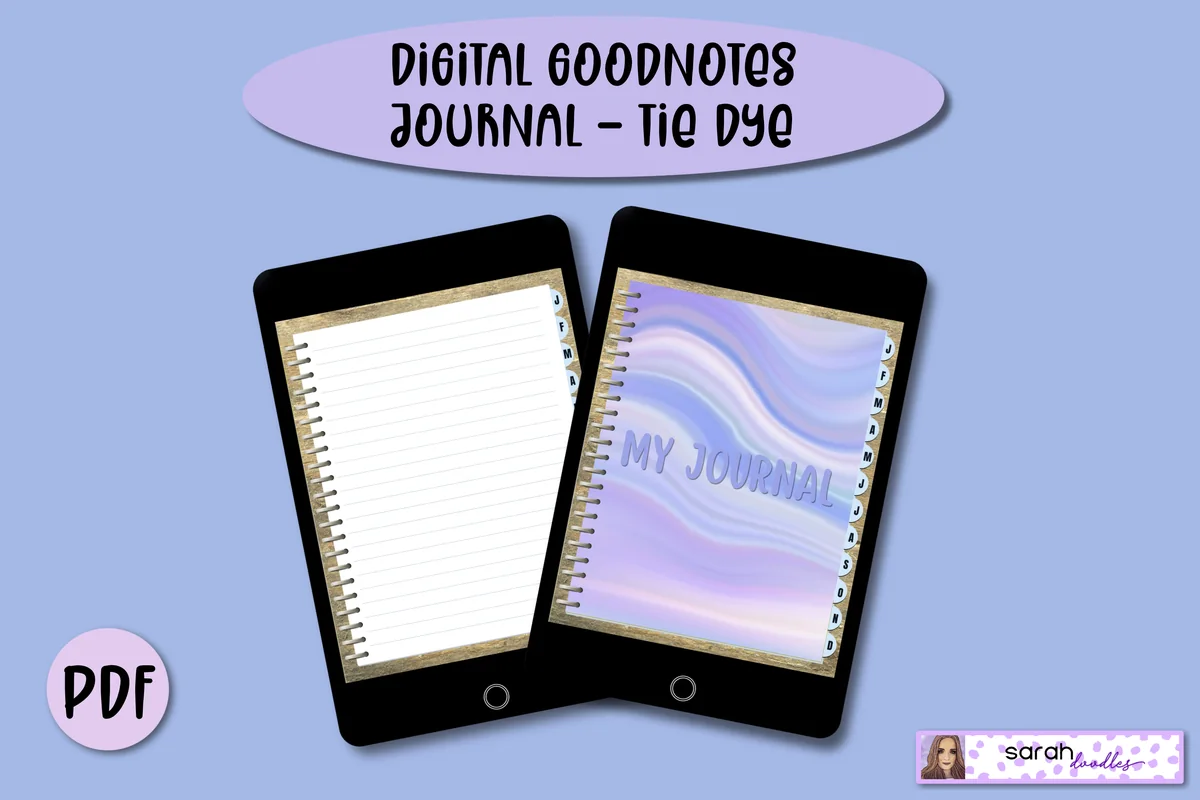
- Monthly divider tabs and five blank lined pages per month
- Additional writing pages can be added in GoodNotes
- The seller recommends an iPad or tablet with Apple Pencil or another stylus
Five lined pages per month suit occasional check-ins. Keep a clean page to duplicate when a month needs more space. The purple tie-dye dividers make this a monthly filing system rather than a page for every day. For the tab links to work in GoodNotes or Notability, the seller specifies selecting the read-only tool.
Best for separating conversation topics
3. Watercolor Hyperlinked Digital Notebook
Orientation: PortraitLayouts: Lined, blank and half-linedDates: No prefilled year shown
Best for: organizing your own pages into distinct subjects. Designed by daysfilledwithjoy.
- One hyperlinked PDF for GoodNotes or a similar PDF annotation app
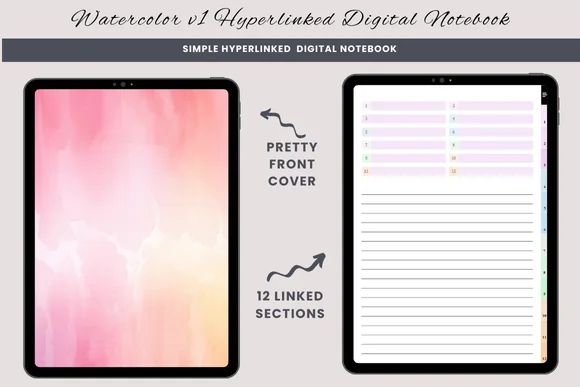
- Twelve sections with lined, blank and half-lined pages
- Blank pages can be duplicated to add writing space
- Pink watercolor cover and numbered section dividers are pictured
Twelve linked sections let you keep household plans, appreciation and difficult conversations apart. The half-lined page leaves room for a sketch or keywords above a written reflection. Give each section your own heading, then duplicate the page style you need. Choose this when finding notes by subject matters more than a daily sequence.
Best for a dark writing page
4. Dark Mode Digital Notebook – Gold Theme
Orientation: PortraitLayouts: Eight dark paper layoutsDates: No prefilled year shown
Best for: writing a short observation beside your interpretation. Designed by catsquills.
- Portrait cover and papers for GoodNotes or Notability
- PDF and PNG formats
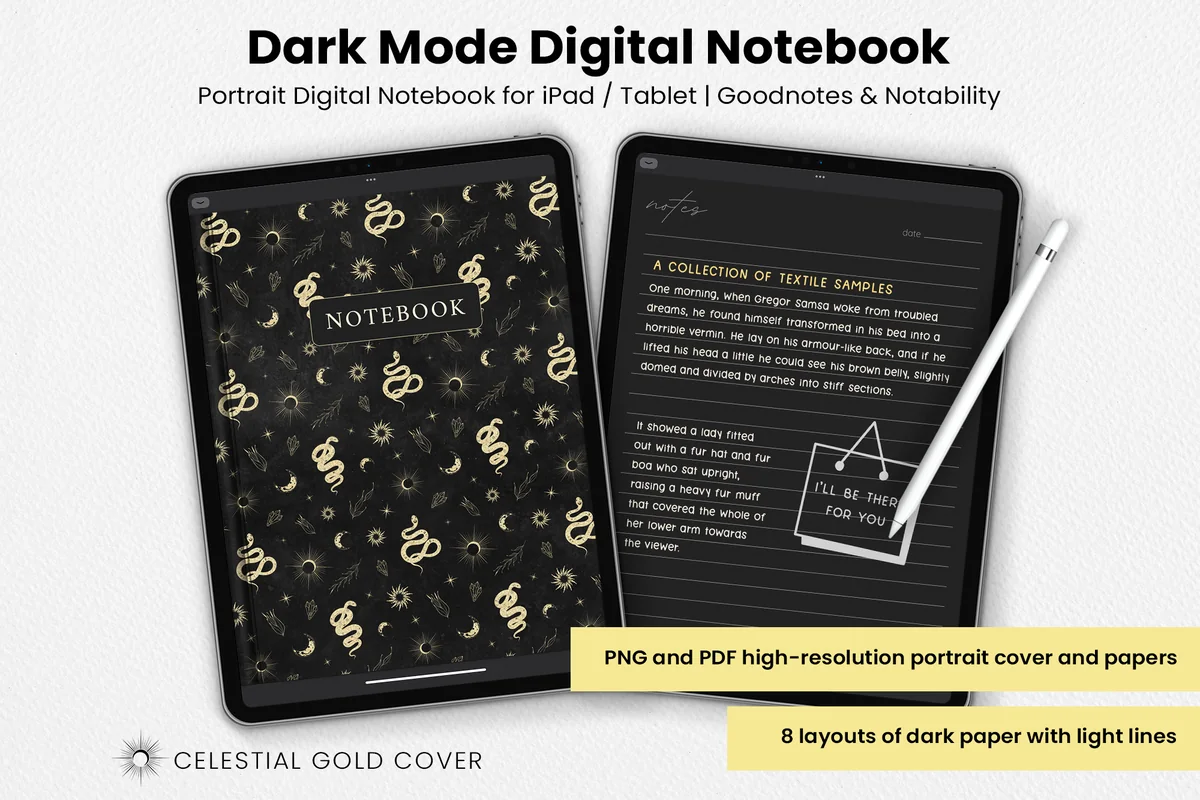
- Eight layouts include columns, numbered list, to-do, lines and notes
- Black paper with light lines and a gold celestial cover is pictured
The column paper suits a simple split: what happened on the left, what I assumed on the right. Choose this for the dark writing surface and eight paper layouts; a fully linked daily journal is not promised. Use a writing color that stands out against the black background. The celestial gold cover is decorative.
Best for notes beside shared plans
5. Undated Digital Planner Journal Goodnote
Orientation: LandscapeLayouts: Daily journal, weekly plans and monthly memoriesDates: Undated
Best for: keeping a personal reflection near calendar and planning pages. Designed by ArtistryByAnnabel.
- A 59-page PDF for GoodNotes on iPad or a compatible note-taking app
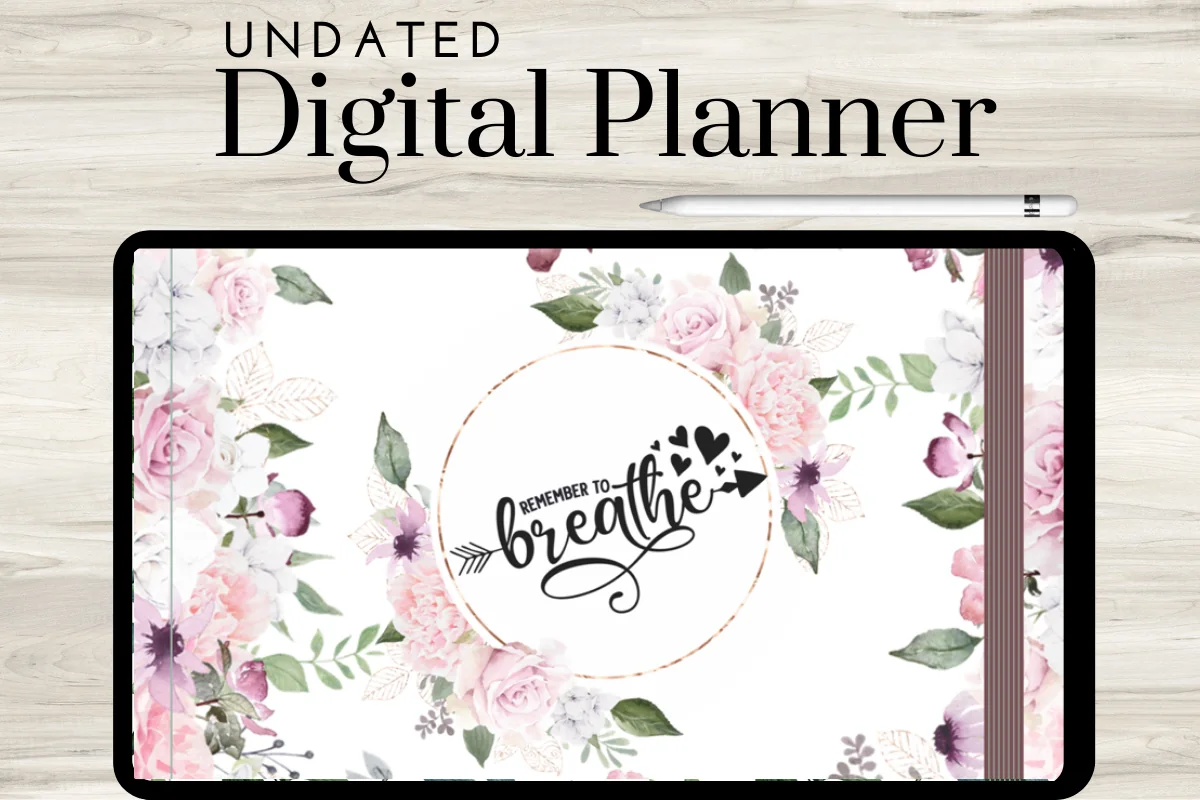
- Landscape two-page view with clickable tab links
- Previews show weekly appointments, daily planning with a journal page, and monthly memories
- The general planner also contains meal, gratitude, Bible study and password pages
The daily journal, monthly gratitude and memory spaces, and weekly appointments make this the broadest option. It suits reflection beside an ordinary planning routine, with a floral landscape spread instead of a plain notebook. Extra Bible-study sections can be removed in Goodnotes. If you only want conversation notes, the smaller journals above involve fewer unrelated pages.
Quick Comparison
| Journal | Writing task | Page structure | Main distinction |
|---|---|---|---|
| 1. 365 Days Daily- Digital Journal | Longer before-and-after entries | 365 linked daily pages | Narrow or wide lines |
| 2. Digital GoodNotes Journal – Tie Dye | Brief monthly check-ins | Five pages per month | Monthly linked tabs |
| 3. Watercolor Hyperlinked Digital Notebook | Separate subjects | 12 linked sections | Lined, blank, half-lined |
| 4. Dark Mode Digital Notebook – Gold Theme | Observation versus interpretation | Eight dark layouts | PNG and PDF papers |
| 5. Undated Digital Planner Journal Goodnote | Reflection near daily plans | 59-page linked PDF | Landscape two-page view |
Keep the Follow-Up Short Enough to Use
After a conversation, the useful record may be much shorter than the preparation. Keep it close to the original entry so you can distinguish what you anticipated from what you actually heard. You do not have to copy every sentence spoken.
- Heard: One new detail or perspective, with uncertain wording marked as a paraphrase.
- Agreed: A specific action only if the people involved accepted it.
- Open: One point that still needs discussion, without assigning blame in the margin.
- Next: Your own next action or an agreed time to return to the topic.
For a monthly journal, keep entries in chronological order under the relevant tab. In a sectioned notebook, use a short topic title so a household-planning question does not get mixed with a private appreciation entry. If you want to compare writing layouts more broadly, see my GoodNotes journal shortlist.
Personal Pages, Shared Questions and Privacy
A private entry and a shared page serve different purposes. The private version can hold unfinished thoughts. A shared version should contain only what you both choose to discuss or record; handing over an entire journal is not required to ask one question.
- Writing alone: Focus on your observations, needs and choices. Leave the other person’s answer blank.
- Writing together: Agree on the question and whether either person can pass. Do not score or compare answers as proof of affection.
- Sharing a page: Check whether it includes earlier entries, names or details you intended to keep private before showing it.
- Keeping a routine: Return when there is something to reflect on. An occasional useful entry is preferable to filling pages only to maintain a streak.
If you want questions that are less conversation-focused, the general journaling prompts cover other starting points. This guide stays with the loop from one episode to a question, a conversation and a short follow-up.
FAQ: Relationship Journaling Questions
Can I use these prompts without my partner?
Yes. They are written for your own preparation and reflection. You can decide what you want to ask without expecting the other person to write, read your private notes or provide a matching answer.
How many relationship prompts should I answer at once?
One is a practical starting point. If it leads to a clear question or request, you can stop there. There is no required number of answers or daily schedule, and completing every prompt is not a measure of progress.
Can these be journal prompts for dating or friendships?
Use the questions that fit the relationship you actually have. Appreciation, shared plans and clarifying an assumption can apply beyond a long-term partnership. Skip questions that presume agreements or responsibilities you have not made together.
Do the iPad journals include these prompts as a PDF?
You can type or handwrite a chosen question from this article into your own journal. For a longer answer, the 365 Days journal offers narrow-lined and wide-lined pages; for notes by subject, the Watercolor notebook provides twelve linked sections.
When is journaling not enough?
These exercises are not mental health treatment or a safety plan. If you feel unsafe, pressured or afraid of the consequences of a conversation, prioritize appropriate support rather than using a journal to prepare for confrontation. For persistent distress, seek qualified professional support.
Can I bring a relationship journal to counseling?
If you attend couples therapy or couples counseling, ask your therapist whether a short entry would be useful in your sessions. Choose the passage you are comfortable discussing and keep unrelated private pages out of the shared copy. This article offers personal writing exercises, rather than a therapy journal or expert treatment plan for trauma or relationship OCD.
Leave With One Question You Can Actually Ask
The point of these journal prompts for relationships is to make one conversation more concrete: what happened, what it meant to you, what you want to ask and what you learned afterward. Choose a question that fits today, give it a few honest lines, and leave room for an answer you have not written yourself.
You May Also Like
This article contains affiliate links. If you purchase through them, I may earn a commission at no extra cost to you. Read the affiliate disclosure.