The jacket looks polished, the eyes have highlights, and the person still feels like someone you have seen in a dozen other sketches. More detail may not be the missing piece. These Procreate character design ideas start with decisions you can read from across the canvas: a shape, a habit, a posture or an object that belongs to one particular person.
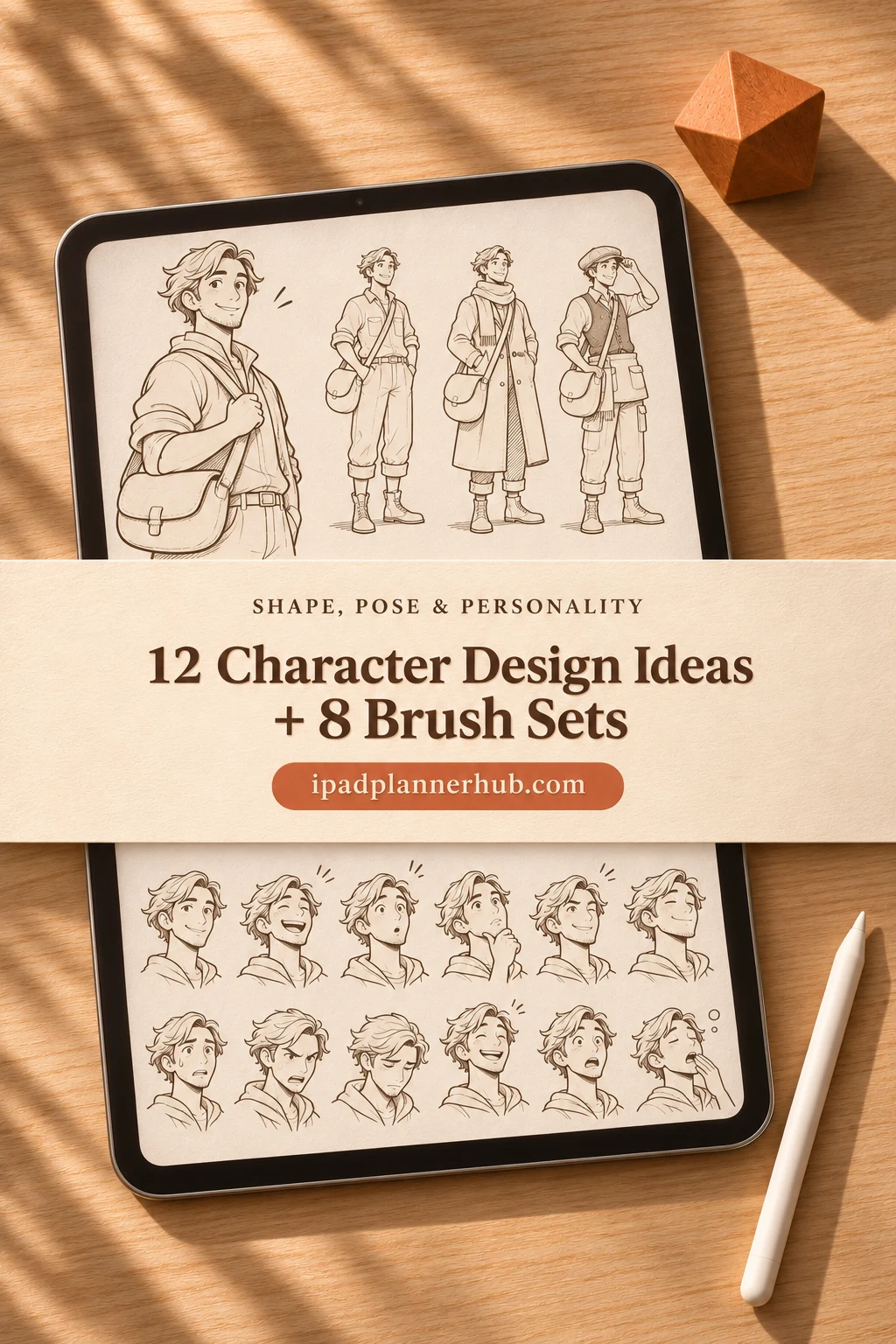
I have put together twelve bounded drawing prompts, followed by eight optional brush and stamp sets for different stages. You can start with brushes already in Procreate. The prompts are original exercises to draw yourself; the sets supply marks or prepared bases, not the finished characters described here.
Build a Person Around One Visible Clue
Write a short brief before drawing: who is this person, what are they trying to do, and what gets in the way? Try an adult bicycle courier who protects a fragile parcel, or a repair-shop owner who keeps every useful scrap. Give the character one clear task rather than a page of biography that never reaches the drawing.
For creative inspiration, observe how people carry tools, protect belongings or arrange a workspace. Artists can bring those observations into an invented costume: a carefully patched pocket tells a different story from a pristine uniform. Let the accessories reflect the character’s routine, and give your creativity a concrete question to answer in the sketch.
- Keep one anchor: a bag shape, hairstyle, collar or repeated color stays recognizable across variations.
- Change one decision: compare posture, costume or palette separately so the difference is readable.
- Choose an endpoint: finish a pair of thumbnails or a small sheet before turning it into a full illustration.
Procreate’s Exploring Character lesson uses basic shapes to develop personalities. For this article, shapes are starting constraints, not rules that a round person must be kind or a pointed person must be dangerous. Your character’s actions can contradict the first impression.
12 Procreate Character Design Ideas to Draw as Small Studies
Each prompt names a visible outcome. Work loosely enough to compare alternatives, then select one version to develop. These are design exercises rather than anatomy lessons; use an appropriate reference when you need to understand how a body, garment or object is constructed.
Shape and Story Clues
- 1Give the same courier two silhouettes. Draw one adult courier with a rounded helmet and circular satchel, then a second version with an angular hood and narrow rectangular bag. Keep the job, height and task the same. Fill each figure as a flat shape before drawing the face. Leave visible gaps between an arm and the torso or between the legs where the pose needs them. Your endpoint is two readable silhouettes with a note about which one better suits the character you want, not a claim that either shape has a fixed personality.
- 2Make one occupation wear three costumes. Choose a florist, mechanic or museum guide. Sketch three outfits around the same body: one with a short wide jacket, one with a long narrow outer layer and one with prominent sleeves. Keep the work tool consistent so you are comparing costume rather than three unrelated people. Place pockets where the character could plausibly reach them. Select a version and circle one clothing detail to carry into the final drawing. Three costume thumbnails are enough; the fabric does not need a finished texture.
- 3Let a treasured prop reveal a habit. Give a repair-shop owner an old tin of carefully sorted screws, a courier a patched delivery bag, or a musician a case covered in homemade labels. Draw the person holding or using the object rather than placing it beside them without a relationship. Add one visible sign of care: a repaired strap, a fitted compartment or a protective cover. Finish with a small prop close-up and a character thumbnail. Let the wear come from a particular activity instead of covering every surface with random scratches.
- 4Lay out the contents of a pocket. Invent four everyday objects that belong to one adult character: a folded route map, a spare button, a blunt pencil and a neatly wrapped snack, for example. Arrange them beside a simple half-body drawing. Choose one object the character keeps accessible and another that is almost forgotten. Their placement and condition can suggest a routine without explanatory dialogue. The endpoint is a pocket inventory and one sentence of backstory. Keep the inventory connected to the character’s task rather than collecting decorative objects from unrelated themes.
Posture, Expression and Relationships
- 5Draw three expressions without replacing the face. Keep the head shape, hairstyle and distinctive feature consistent across three thumbnails. Show a character receiving surprising news, trying to hide amusement and concentrating on a small repair. Change brows, eyelids and mouth placement deliberately; do not simply replace the head with a completely different drawing. Make the expression understandable before adding shine to the eyes. Put the three heads beside the same short character description. If they no longer look like one person, choose an anchor to restore before polishing the expression.
- 6Change the posture before changing the costume. Draw a character waiting outside a job interview, then greeting a friend after it. Keep the outfit and bag unchanged. Explore where the weight sits, how tightly the hands hold the bag and whether the shoulders turn toward the other person. A pose base can help you block the body, but the emotional contrast still needs your choices. Finish two full-body thumbnails with matching proportions. Avoid making posture a diagnosis of personality; you are showing two moments in one person’s day.
- 7Pair two sidekicks with contrasting habits. Design two adult assistants in a neighborhood theater. One arrives with a neatly labeled tool roll; the other carries a crowded tray and keeps borrowing the pencil behind their ear. Give them a shared badge or costume color, then contrast the way each person stands and handles their equipment. Do not rely only on a height difference to distinguish them. The endpoint is a paired lineup with one shared task. Add a small interaction, such as passing a brush, so they feel connected rather than pasted onto the same page.
- 8Show the same person at a doorway and on a stage. Choose someone who performs or presents: a storyteller, singer or community speaker. In the doorway thumbnail, make the figure respond to the narrow space with a turned shoulder and a bag held close. On the stage, give the same person room to gesture. Preserve a recognizable coat, hair shape or accessory in both views. Finish the scene as two small panels without elaborate backgrounds. This is a composition and posture exercise, not a requirement that the person suddenly gains an entirely different personality.
Costume Variations and a Small Character Sheet
- 9Redesign an outfit for a rainy day. Start with the courier or shop owner you already drew. Add a rain layer, change the footwear and protect the object they need for work. Consider which changes alter the silhouette and which can remain small details. A loose scarf may look appealing, but ask how it behaves during the chosen activity. Finish a dry-weather and wet-weather pair. Keep the same underlying proportions and identify one practical change in each version; a new color alone does not complete the redesign.
- 10Keep one costume and compare three palettes. Draw three copies of the same simple outfit. Use a small palette for each, keeping the largest light and dark areas easy to compare. Try a quiet neutral version, a version with one bright accessory and a version that repeats the setting’s colors. For an anime character study, keep the face and linework identical while you vary the clothing. Finish with three swatches and a chosen thumbnail. These are color experiments, not a promise that one combination will suit every screen or every character.
- 11Suggest different life stages through choices. Draw the same adult character at two imagined stages of their life. Preserve the recognizable nose, hairline or favorite accessory, then change clothing fit, grooming or the way they carry a familiar object. Let the story decide the differences: a repaired bag could appear in both drawings, while a new role adds a work badge. Avoid treating age as a fixed posture or a set of stereotypes. Finish a paired study with notes about what stayed constant and what changed for a specific reason.
- 12Collect the decisions in a mini character sheet. Choose your most readable version and arrange a front view, a side or three-quarter study, two expressions and a prop close-up on one page. Keep a small color swatch near the figure and label the details you want to preserve. This is a personal consistency sheet, not a full production turnaround with every angle solved. Leave room around the figure so annotations do not overlap the drawing. Your endpoint is a usable reference for the next illustration, rather than twelve more disconnected experiments.
Keep Variations Separate While You Compare Them
Procreate’s Layers interface guide explains that layers can be moved, duplicated and edited without altering other layers. That supports a useful working arrangement: keep your original sketch and make alternatives beside or above it instead of painting over every earlier decision. The exact layer arrangement is your choice.
A Repeatable Character Study
- 1Write the visible brief. Name the person’s activity and the one design question you want to answer. “A courier protecting a parcel in rain” gives you clothing and posture decisions to explore. Keep the brief nearby while you draw so a decorative detour does not replace the task.
- 2Make alternatives on purpose. Preserve the original sketch and put the alternatives on clearly named layers. Try one change per version: a longer jacket, a different bag position or a more open gesture. Duplicate only the material you want to reuse, and keep unfinished variants separate from the chosen drawing.
- 3Compare before rendering. Hide detail layers when you need to compare the large shapes. Look at the chosen version beside the brief and ask what a reader can actually see. If the important clue requires a long explanation, revise its placement or shape before adding texture and small highlights.
- 4Keep a reference version. Label the chosen palette and recurring details on your mini sheet. Retain an editable original while making a separate copy for sharing. The sheet should help you draw the person again; it does not need decorative labels, a complex border or a polished background to do that job.
Compare Light and Texture on the Same Character
For a digital art study, keep the flat colors and test shadows on a separate layer using Multiply in the blend modes. Compare the result with that layer hidden so the lighting supports the character’s form without obscuring the face or costume. Add a few textural marks to the worn bag, then stop while the main visual elements still read at a tiny thumbnail size.
Which Optional Tools Match the Part You Want to Practice?
Match the tool to the task that is slowing the study down. Sketch brushes make marks; pose stamps supply body-part bases; prepared head stamps already supply face and hair outlines. Those are different starting points. A larger set does not make a character more original, and none of these sets replaces the twelve drawing decisions above.
TL;DR: Twelve drawing prompts start with shape, posture and story clues. The eight optional sets below support sketching, assembled pose bases, prepared anime heads or finishing details. They supply tools, not twelve finished character designs.
Quick Picks
- Best for small sketch toolkit: Sketch Brushes for Procreate
- Best for soft anime rendering: Procreate Sketch Soft Brushes
- Best for linework and washes: Character Design Procreate Brushes
- Best for assembled pose foundations: Character Pose Brush Kit
- Best for alternate body foundations: Character Pose Brush Kit- Male Edition
- Best for prepared anime head outlines: 150 Procreate Woman Head Anime Stamps
- Sketch Brushes for Procreate – small sketch toolkit
- Procreate Sketch Soft Brushes – soft anime rendering
- Character Design Procreate Brushes – linework and washes
- Character Pose Brush Kit – assembled pose foundations
- Character Pose Brush Kit- Male Edition – alternate body foundations
- 150 Procreate Woman Head Anime Stamps – prepared anime head outlines
- Procreate Portrait Realistic Brushes – painted face detail
- Procreate Hair Brushes Set – strand texture
Sketch the Shape Before the Details
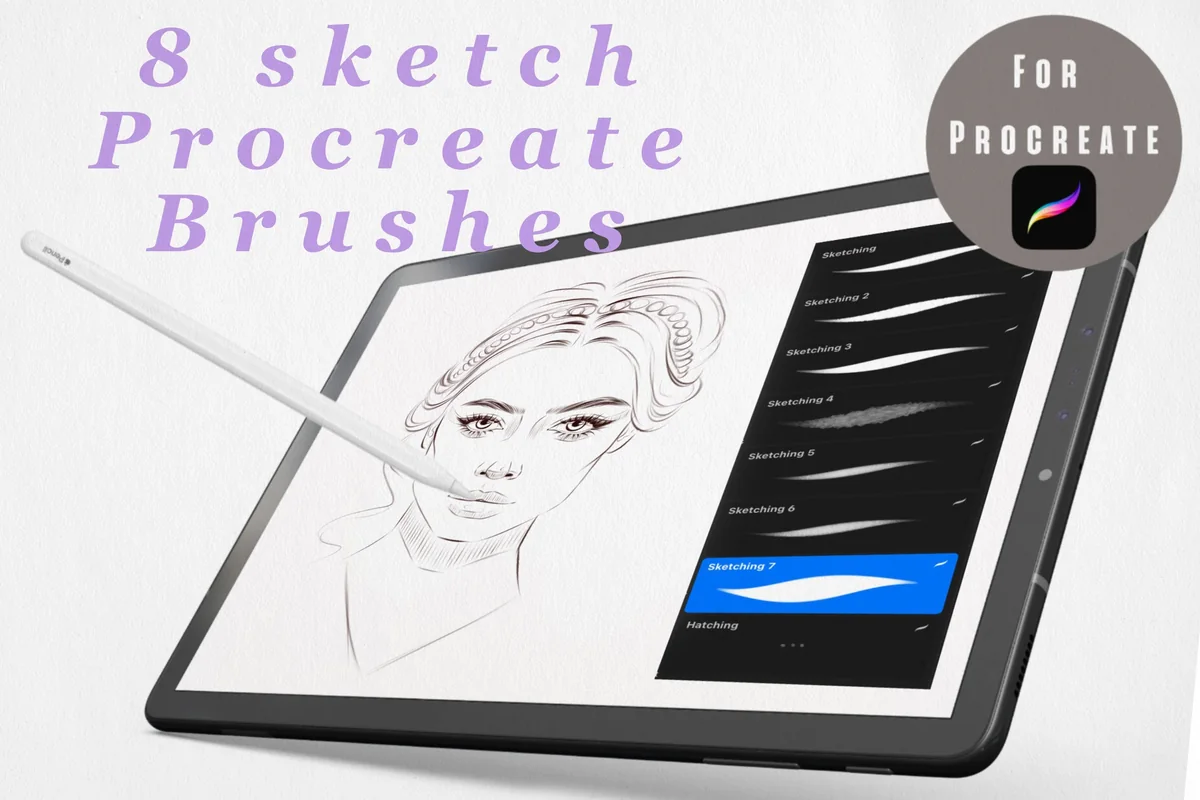
small sketch toolkit
1. Sketch Brushes for Procreate
Format: Procreate brushes
Best for: testing silhouettes without a large library. Designed by Ssolovyeva Designs.
- 8 sketch brushes for Procreate
- Stroke samples include a hatching brush
- Designed for iPad and Procreate
Eight brushes make this the most contained sketch choice here. I like its focus for the silhouette exercises: compare the shape decisions before comparing dozens of textures. The portrait in the gallery is an example of the tools in use, not a character sheet included in the pack.

soft anime rendering
2. Procreate Sketch Soft Brushes
Format: Procreate brushes
Best for: taking a rough character toward a soft painted finish. Designed by EasyProcreate.
- 39 Procreate brushes
- Sketch, drawing, shading and blending tools
- Pencil and paper-texture brushes
The gallery separates linework, soft shading and paper texture, which helps explain the broader scope of this set. It suits the anime variation if you want to carry one drawing beyond the thumbnail stage. Judge the 39-brush set on its own contents; the multi-buy graphic advertises a separate promotion.
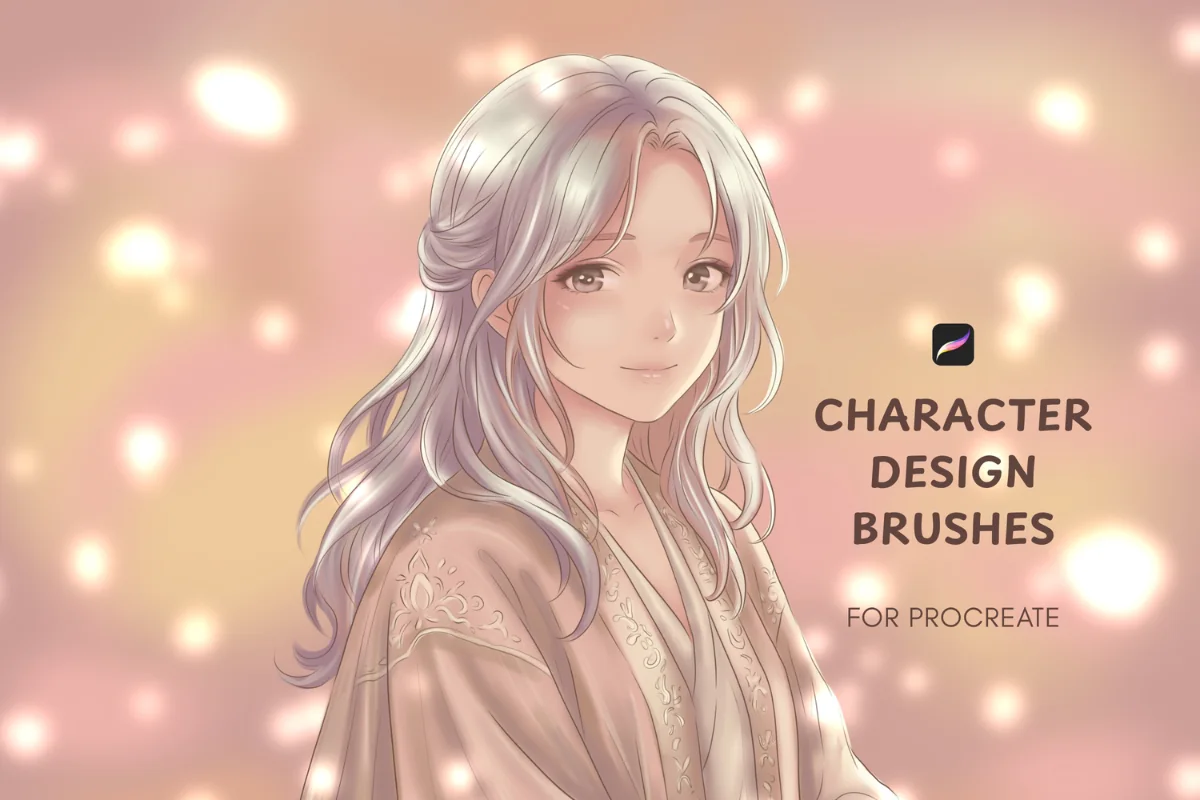
linework and washes
3. Character Design Procreate Brushes
Format: Procreate brushes
Best for: switching between costume lines and loose painted areas. Designed by Eve Zo Art.
- 15 specialized brushes in a .brushset
- PDF user guide in a ZIP archive
- Listing specifies Procreate 5 or newer on a compatible iPad
This set moves from fine marks to broad washes rather than supplying pose stamps. Its gallery includes both a softly painted portrait and a graphic costume study. That range interests me for the weatherproof outfit prompt, but the character concept and clothing decisions still come from you.
Optional Bases for Poses and Heads
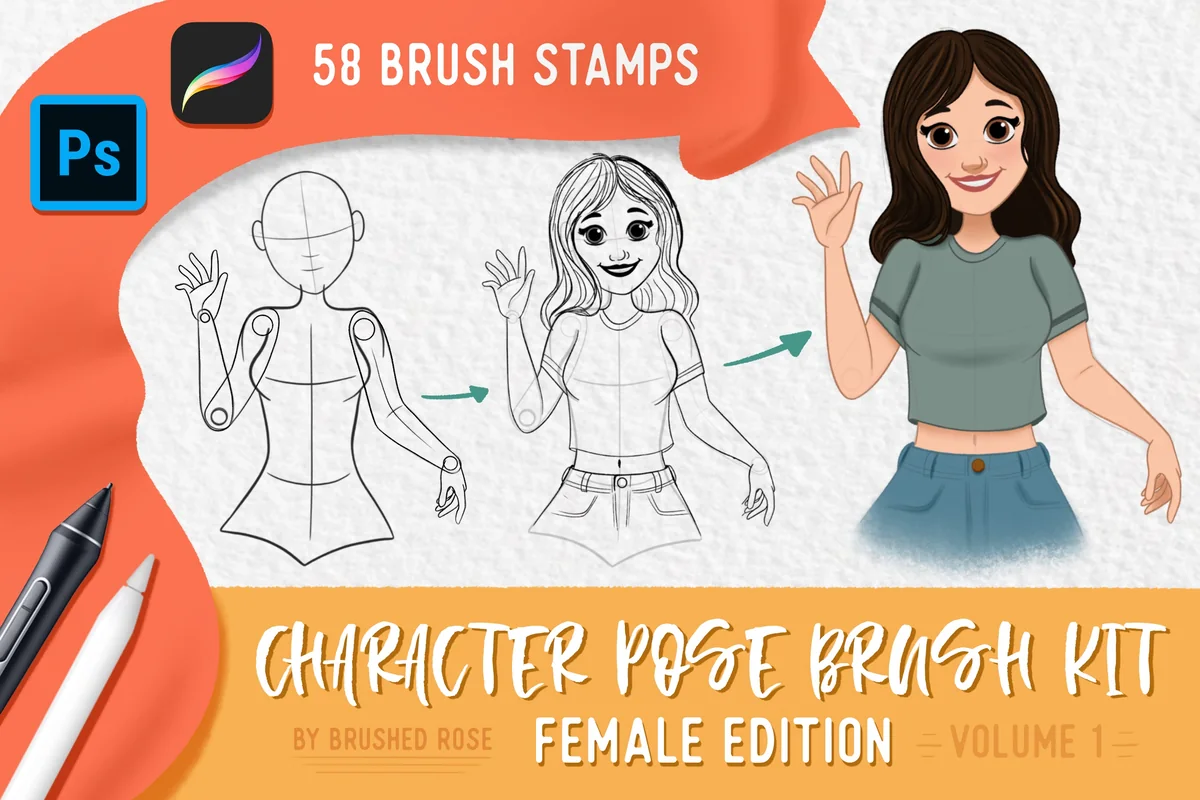
assembled pose foundations
4. Character Pose Brush Kit
Format: Procreate brush stamps
Best for: blocking a body before designing clothing. Designed by Brushed Rose.
- 58 brush stamps for Procreate and Photoshop
- 6 arms, 8 hands, 16 torsos
- 10 legs, 6 feet and 12 heads
Separate body parts are the useful distinction: this is a construction kit, not 58 finished poses. The gallery shows a base, a sketch and a colored result as different stages. Use the base to explore posture, then draw your own outer contour and clothing instead of treating the mannequin as the finished design.
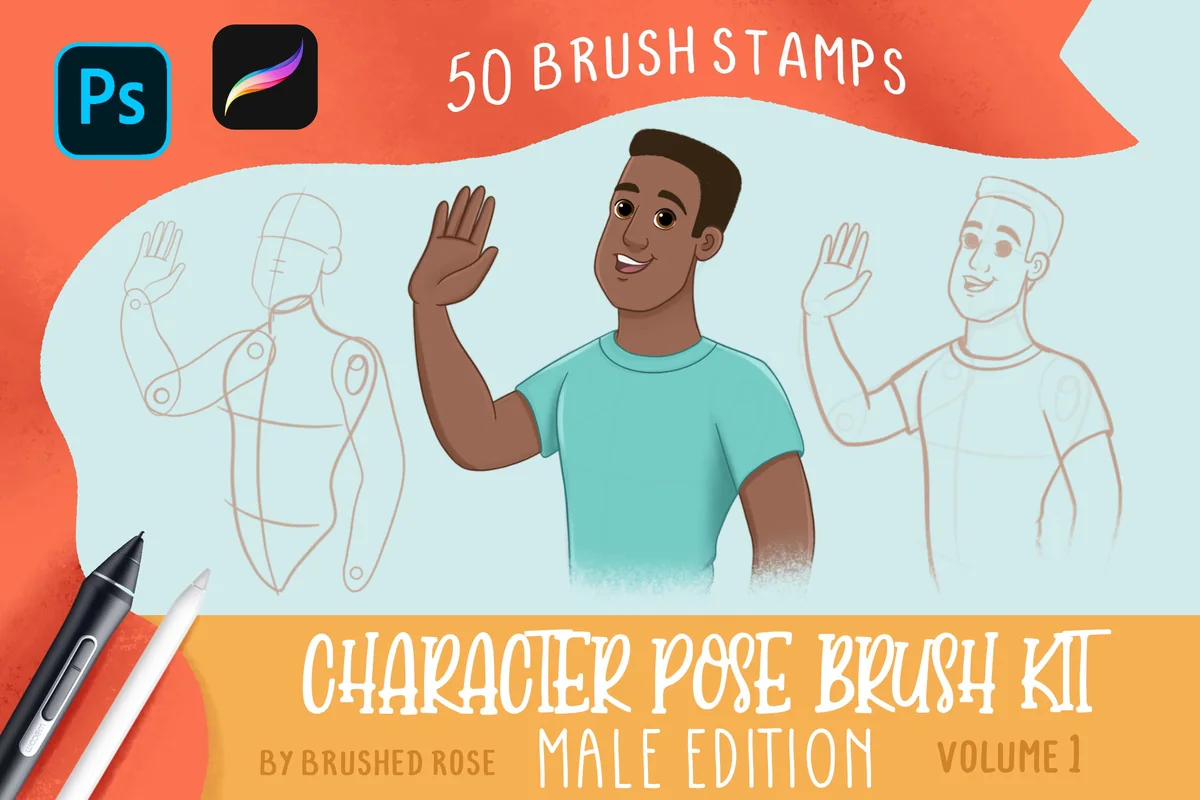
alternate body foundations
5. Character Pose Brush Kit- Male Edition
Format: Procreate brush stamps
Best for: exploring another set of torso and head shapes. Designed by Brushed Rose.
- 50 brush stamps for Procreate and Photoshop
- 6 arms, 8 hands, 9 torsos
- 10 legs, 5 feet and 12 heads
The second pose kit has a different body-part assortment, including nine torsos rather than sixteen. Choose between the two by the bases shown, not by assuming you need both. Its loose construction examples leave room to change proportions and costume; the colored person is an example, not a ready-made character promised in the files.
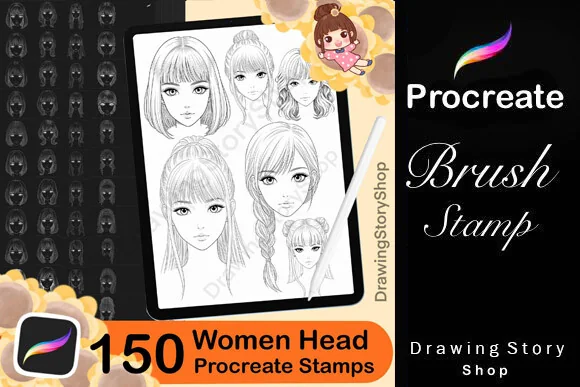
prepared anime head outlines
6. 150 Procreate Woman Head Anime Stamps
Format: Procreate brush stamps
Best for: color and hairstyle studies on an existing face base. Designed by DrawingStoryShop.
- 150 woman head stamps for Procreate on iPad
- PDF brush-import instructions
- Gallery shows prepared face and hairstyle outlines
These stamps already decide much of the face and hair outline. They can be a starting point for the palette exercise, but they are a narrower fit for inventing an original silhouette. If your goal is a character designed entirely by you, use your own head sketch instead; coloring a prepared outline is a different exercise.
Finish a Face or Hair Study
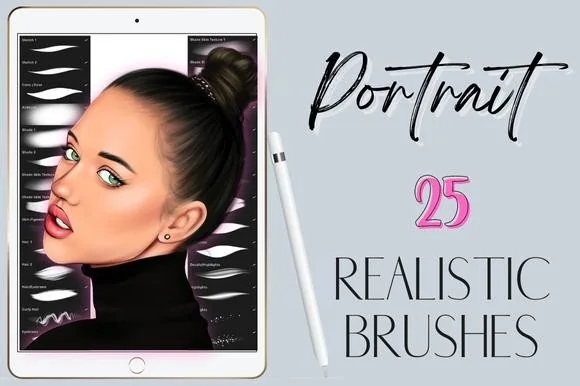
painted face detail
7. Procreate Portrait Realistic Brushes
Format: Procreate brushes
Best for: a close-up after the character concept is settled. Designed by Calcool.
- 25 brushes in one ZIP archive
- Sketch, skin, shading, blending and smudge tools
- Hair, facial details, highlights and glitter brushes
Leave this one until the face needs more rendering. The gallery emphasizes skin and close-up detail, so it does less for the silhouette and costume decisions that drive this article. It is a supporting option for a finished head study, with Procreate on iPad and Apple Pencil explicitly required by the listing.

strand texture
8. Procreate Hair Brushes Set
Format: Procreate brushes
Best for: adding directional strands to a chosen hair mass. Designed by Calcool.
- 30 hair brushes
- Gallery shows individual stroke samples
- Only for the Procreate app on iPad
The stroke sheet shows hair marks, not complete hairstyle stamps. That distinction matters for the life-stage study: choose the large hair shape yourself, then decide whether strand detail adds anything. There is little reason to buy a dedicated hair set while the overall head silhouette is still undecided.
Quick Comparison
| Tool | Role | Contents | Try it for |
|---|---|---|---|
| 1. Sketch Brushes for Procreate | Sketching | 8 brushes | Silhouette pair |
| 2. Procreate Sketch Soft Brushes | Sketch to color | 39 brushes | Anime variation |
| 3. Character Design Procreate Brushes | Lines and washes | 15 brushes + guide | Weather outfit |
| 4. Character Pose Brush Kit | Pose construction | 58 part stamps | Posture pair |
| 5. Character Pose Brush Kit- Male Edition | Pose construction | 50 part stamps | Stage posture |
| 6. 150 Procreate Woman Head Anime Stamps | Prepared head bases | 150 stamps + guide | Palette study |
| 7. Procreate Portrait Realistic Brushes | Portrait finishing | 25 brushes | Expression close-up |
| 8. Procreate Hair Brushes Set | Hair finishing | 30 brushes | Hair variation |
Before You Buy Another Character Design Brush Set
Start with the stage you are actually practicing. If the courier still has no readable bag shape, skin texture is unlikely to answer that question. Keep the first study restricted to a sketching tool and add a specialist set when its role becomes clear.
- Inventing from scratch: use your own silhouettes and heads. The eight-brush sketch set is the contained option; the 39-brush soft set includes more rendering roles.
- Struggling to arrange a pose: compare the two body-part kits. They offer different assortments, and neither is a collection of fully clothed finished people.
- Practicing color on an existing outline: the anime head stamps provide prepared bases. That is different from designing every feature yourself.
- Finishing an established design: portrait and hair brushes address details after the large decisions are settled.
For more about a clean contour, see the Procreate lineart brush comparison. It addresses the line stage rather than supplying a character concept. Keep that distinction in mind when a tool looks attractive but does not solve the drawing question in front of you.
A Small Review Before Calling the Sheet Finished
- Can you recognize the same person in the costume and expression variations?
- Does the prop connect to an activity shown in the drawing?
- Is the pose readable without the background explaining everything?
- Have you distinguished prepared stamp outlines from your own original construction?
- Have you kept the reference colors and distinctive details where you can find them next time?
If the sheet becomes crowded, remove a repeated view instead of shrinking every drawing. One clear version with a few useful variations is a better reference for your next illustration than a dense page whose details you cannot compare.
FAQ: Character Prompts and Brush Choices
What is an easy character idea to start with?
Try the silhouette pair with one adult character and one bag. Skip the facial rendering and compare just two versions. The easy part is the limited scope, not a guarantee that your first sketch will solve every proportion.
How can I adapt Procreate character design ideas for anime?
Start with the courier and keep the bag, costume and task while you choose anime facial proportions and linework. Draw three expressions with the same head structure, then try a dynamic pose that shows the parcel’s weight through the shoulders and arms. Keep the hair and clothing consistent so the artwork still shows one recognizable person in motion. The soft sketch set supports that rendering direction; the prepared anime head stamps offer an existing outline instead of an original head-design exercise.
Do I need paid brushes for character design?
No. Start with brushes already in your Procreate library and finish a small study. Buy a set only if its particular marks or bases fit a problem you can name. The products here are optional tools, not prerequisites for the prompts.
Would a Procreate character design course help with these studies?
Use a course when you need instruction on a specific decision, such as constructing the body or making a gesture readable. Choose a tutorial that shows the process from a rough concept to a finished character, and watch how the illustrator compares alternatives before rendering. Pause the videos and apply those tips to your own courier study so you practice creating a character rather than copying the finished example. A stamp kit supplies prepared shapes to assemble or draw over; it does not replace those lessons.
Should a character sheet contain every angle?
For a personal study, choose the views you need to keep the character consistent in your next drawing. A front view, another angle, expressions and a prop can be a useful small endpoint. A professional production brief may require a much more specific turnaround.
Choose the Clue You Want to Draw Again
The useful endpoint for these Procreate character design ideas is one person you want to revisit. Keep the bag, collar or gesture that makes the character recognizable, and carry it into another small scene. Leave the rest of the experiments available as alternatives instead of forcing them into the finished design.
My first choice would be the courier silhouette pair, followed by the rainy outfit and the mini sheet. That sequence keeps the same character in view while the questions change. Add a specialist brush pack only if it helps with the next question you want to answer.
You May Also Like
This article contains affiliate links. If you purchase through them, I may earn a commission at no extra cost to you. Read the affiliate disclosure.