You roll up the mat, put the props away and realize you can no longer remember the instruction that made a pose feel different. A quick note can give that detail somewhere to land. These yoga journal ideas turn a blank iPad page into a record of the class you actually attended, with space for what you noticed and what you want to ask next.
Start with one short entry per practice, then add a separate learning page when you need room for questions or vocabulary. You do not need to answer 25 prompts after every class. Choose two or three that fit today, and leave the rest for another session. Below are five digital journals to adapt, followed by 25 prompts organized around a real practice.
Choose a page that matches how you write
All five options are general journals or notebooks for iPad. None is presented here as a specialist yoga workbook, an exercise program or a library of pose instructions. The useful difference is how each one holds your own notes: by topic, by date, in short frames or behind monthly dividers.
TL;DR: Five general iPad journals offer different starting points: separate sections, full ruled pages, short calendar notes, a simple decorated page or monthly filing. The 25 yoga journal ideas below are layouts and prompts you add yourself.
Quick Picks
- Best for separate practice sections: Digital Notebook
- Best for longer class reflections: Digital Ruled Journal
- Best for short weekly check-ins: Undated Cute Orange Bullet Journal
- Best for a simple lined page: DaisyNotes | Digital Notebook | Purple
- Best for monthly reviews: Digital GoodNotes Journal – Art Deco
- Digital Notebook – Best for separate practice sections
- Digital Ruled Journal – Best for longer class reflections
- Undated Cute Orange Bullet Journal – Best for short weekly check-ins
- DaisyNotes | Digital Notebook | Purple – Best for a simple lined page
- Digital GoodNotes Journal – Art Deco – Best for monthly reviews

Best for separate practice sections
1. Digital Notebook
Orientation: LandscapeLayouts: 12 sections; 16 note templates
Best for: separating session logs, pose notes and teacher questions. Designed by Shades of Zen.
- Twelve expandable sections with hyperlinked tabs and individual dividers
- Sixteen templates including lined, dot-grid, graph, two-column and Cornell notes
- GoodNotes and PDF annotation apps named in the listing
Separate sections suit yoga notes that mix several kinds of information. Put class entries in one section, pose vocabulary in another and questions in a third. The two-column template gives a cue and your response separate places. Its landscape spread also leaves room for a small sketch, although the binder artwork uses part of the screen. These are general note templates, not ready-made yoga worksheets.

Best for longer class reflections
2. Digital Ruled Journal
Orientation: PortraitLayouts: 366 ruled pages; month and day index
Best for: writing a fuller account of each practice in date order. Designed by Island Tulip Designs Co.
- 366 ruled pages with hyperlinked navigation
- Three floral covers and a paper-like design
- Forty general journal prompts in PNG and precropped GoodNotes formats
The attraction here is writing space. A class that leaves you with a question, a useful instruction and several observations can have a proper entry instead of three cramped boxes. The previews show months and numbered days rather than a weekday calendar tied to a particular year. Add the class title yourself. Keep the included general prompts on their own pages so dated class entries stay easy to scan.
Best for short weekly check-ins
3. Undated Cute Orange Bullet Journal
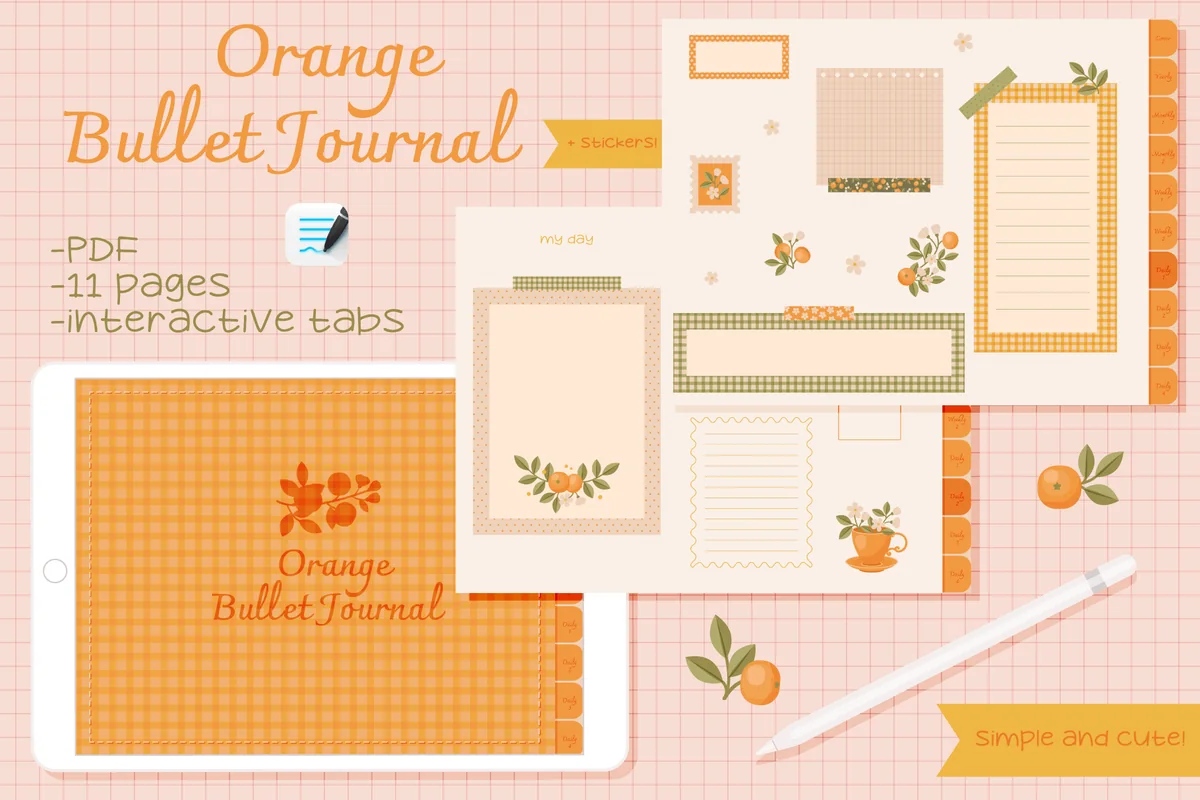
Orientation: LandscapeLayouts: 11 journal pages; interactive tabs
Best for: recording brief practice notes beside an undated calendar. Designed by digitaliya_studio.
- Interactive PDF bullet journal for GoodNotes
- Yearly, monthly, weekly and daily layouts pictured
- GoodNotes-format stickers; orange and floral decoration
The orange frames make this a cheerful option for a compact entry. Mark a practice on the calendar, then use a daily frame for one thing you noticed and one question. The six previews show short writing areas rather than long ruled pages, so this is not my choice for a detailed class transcript. You create the yoga labels yourself; the product is a general bullet journal.
Best for a simple lined page
4. DaisyNotes | Digital Notebook | Purple
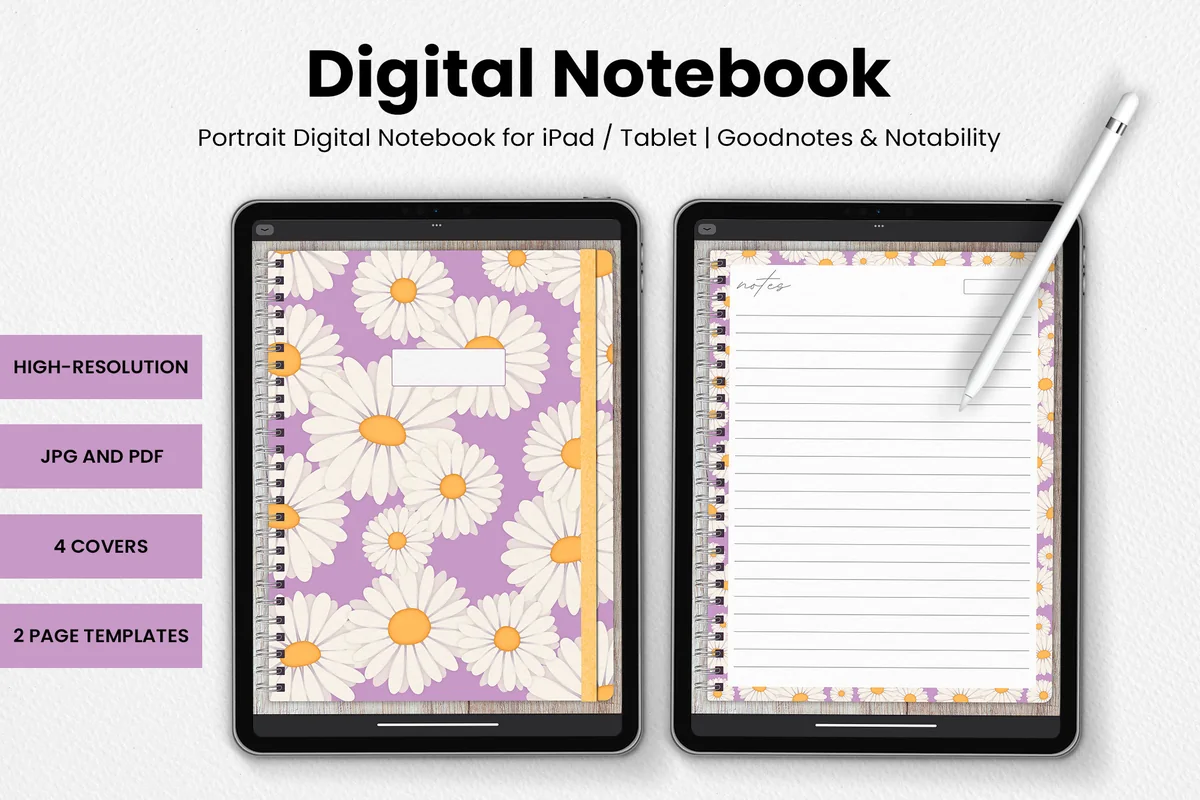
Orientation: PortraitLayouts: 2 page templates; 4 covers
Best for: keeping one handwritten entry without a larger filing system. Designed by catsquills.
- Portrait notebook for GoodNotes and Notability
- Four covers and two page templates
- JPG and PDF formats; daisy borders and ruled pages pictured
DaisyNotes keeps the decision small: choose a page, add the date and write. Its floral border suits a short reflection, while the open lines can hold a teacher question without forcing it into a tracker. A manual index at the front can help you find entries as the notebook grows. There are only two page templates in the listing, and no promise of linked sections, so choose it for a simple page rather than elaborate navigation.

Best for monthly reviews
5. Digital GoodNotes Journal – Art Deco
Orientation: PortraitLayouts: Monthly dividers; lined and brain-dump pages
Best for: filing class reflections by month and clearing loose thoughts. Designed by Sarah Doodles.
- Undated hyperlinked PDF for iPad annotation apps
- Five lined pages initially allocated per month; duplication described
- Brain-dump and Important / Not Important templates pictured
Art Deco makes sense when you think in months rather than in separate topics. Keep session notes behind the current monthly divider and use a brain-dump page for observations you have not sorted yet. Five lined pages per month are the starting allocation, not a daily page for every date; the description explains adding more in GoodNotes. The priority page is a general organizing tool, not a yoga progress score.
Quick Comparison
| Journal | Structure | Useful for | Keep in mind |
|---|---|---|---|
| 1. Digital Notebook | Sectioned notebook | Separate logs and learning notes | Build the yoga headings yourself |
| 2. Digital Ruled Journal | Ruled journal | Detailed entries by date | No built-in pose library |
| 3. Undated Cute Orange Bullet Journal | Undated bullet journal | Brief notes and practice marks | Small framed writing areas |
| 4. DaisyNotes | Digital Notebook | Purple | Decorated notebook | A heading and a few lines | No hyperlinked sections promised |
| 5. Digital GoodNotes Journal – Art Deco | Monthly journal | Monthly filing and reflection | Add pages as your notes grow |
25 yoga journal ideas, from arriving to reviewing
Think of the following groups as a menu. A session entry might take one prompt from the first group and two from the third; a learning page might use only the pose questions. The examples are invented entries to show the layout, not claims about what yoga will do for you.
Before you begin
- 01Name the session. Write the date, approximate time, class title and teacher or video source. Add the actual length afterward if it differs from the plan. A title such as “Tuesday class: standing balance” will be easier to find later than a page headed only “Yoga.”
- 02Write an arrival sentence. Complete “I am arriving with…” in plain language. You might write “a busy mind and little time” or “curiosity about the new class.” Keep the sentence descriptive. You are recording a starting point, not deciding whether you deserve to practice.
- 03Choose an attention cue. Choose one thing to listen for in the lesson, such as how the teacher explains a transition. Record that focus at the top of the page. This is an attention reminder, not an instruction to increase intensity or attempt a more advanced pose.
- 04Note the setting. Record home or studio, the space available and any notable distractions. “Phone notifications interrupted the first few minutes” is useful context when you reread an entry. Avoid turning a preference for a quiet room into a requirement that prevents a short session.
- 05Leave a before-and-after pair. Draw two small boxes labeled Before and After. Put one or two words in the first and leave the second empty until the session ends. The point is to compare your own words that day, including days when you notice no change.
Learn from the class
- 06Keep a pose vocabulary page. Write the name used in class and a brief description that helps you remember which pose it referred to. Add the source beside it. If two teachers use different names, record both rather than guessing that the terms mean exactly the same thing.
- 07Capture one teaching cue. Paraphrase a short instruction that stood out, with the teacher and date. Add what you understood it to mean and a question if needed. Your shorthand is a memory aid; it should not become a universal alignment rule copied into every future session.
- 08Make a question-for-teacher box. Use “What I heard / What I want to clarify” as two headings. For example: “I heard a cue about foot placement; I want to check what it means for this variation.” A specific question is easier to bring to class than a page labeled “confusing.”
- 09Record a taught variation. Note a variation or prop setup introduced by the instructor, plus the class where it was taught. Write only what you can accurately recall and flag uncertainty. Do not turn a remembered sketch into a prescription for yourself or someone else.
- 10Map a short sequence from memory. Use a few names or simple boxes to recall the order of a class segment. Mark gaps with a question mark instead of filling them in. This is a record of the lesson, not a replacement for guided instruction or permission to repeat unfamiliar movements alone.
Reflect after the mat is rolled up
- 11Finish the arrival comparison. Return to the After box and use words that feel accurate now. “Still distracted” is as valid an entry as “more settled.” Avoid forcing a positive ending. The comparison records a moment; it does not demonstrate that the practice caused a particular result.
- 12Save one memorable moment. Describe a specific detail: an instruction you finally understood, a pause you appreciated or a question that came up. Include enough context to recognize the moment next week. “The transition after the seated section” is more useful than an isolated “good class.”
- 13Notice where attention went. Write what repeatedly caught your attention and whether you returned to the lesson. Keep it neutral: “I kept thinking about tomorrow’s appointment.” You do not need to score concentration or explain the thought before the entry can be finished.
- 14Describe effort in your own words. Use a short phrase such as “more demanding than I expected” and note the part of class it refers to. Do not compare it with another person’s practice. A descriptive sentence keeps the context that a single number would lose.
- 15End with one next question. Complete “Next time I want to understand…” rather than setting a pose achievement target. It might be a question about terminology, the lesson structure or an instruction. Carry it forward to the teacher-question page so it can receive an answer.
Build a useful practice archive
- 16Create a class-source index. Keep the class title, teacher, date and source link or reference together. Add a short note explaining why you might revisit it. If a video changes or disappears, your written summary still tells you which lesson the entry referred to.
- 17Track attendance without a streak rule. Mark the days you attended or practiced and use a small key for studio, home or another setting. Leave unmarked days neutral. A monthly view is a record of what happened, not a debt to repay or a reason to add extra sessions.
- 18Separate plans from actual sessions. Use different marks for a class you intend to attend and one you completed. When a plan changes, move or cross out the plan without rewriting the past. For yoga bullet journal ideas that use a calendar, this distinction keeps planned classes separate from the practice log.
- 19Keep a props note. List the props used in a particular taught session and the instruction they accompanied. Include what you want to clarify before using the setup again. Do not infer that owning the same equipment makes an unfamiliar variation appropriate for independent practice.
- 20Collect resolved questions. When you get an answer, add the date and source beside the original question. Keep the original wording visible so you can see what changed in your understanding. If the answer applies only to one class or variation, preserve that limit in the note.
Review without turning practice into a test
- 21Revisit a repeated class. Compare two entries for the same lesson or teacher. Note a difference in what you understood, remembered or asked. Include changed circumstances such as a different setting. A comparison can be useful without proving physical progress or ranking one session above another.
- 22Write a weekly learning summary. Pick one useful cue, one unresolved question and one detail worth remembering from the week. Refer to the session dates rather than copying every entry. If you attended one class, that is enough material; this page does not require a full schedule.
- 23Make a gentle monthly review. Look for repeated questions or practical barriers in your own notes. Perhaps you need a clearer source index or a page with more writing space. Choose one adjustment to the journal itself before setting any new practice goal. The notebook should support the activity.
- 24Save a small appreciation. Write one concrete thing you appreciated about a session, a teacher’s explanation or the opportunity to pause afterward. Keep the wording yours. If appreciation feels forced today, skip this prompt and record an ordinary observation instead; an honest entry is more useful.
- 25Choose what to leave out. Review the fields you keep skipping and remove one that adds little. You might retain only date, source, observation and question. A yoga journal can change with your needs. Keeping every decorative tracker is not a condition of having a worthwhile practice record.
Set up a yoga journal on iPad in four small steps
For yoga journal ideas in PDF form, the simplest approach is to add your headings to a general page in a compatible annotation app. Choose the structure first, then the decoration. The products above provide general pages; the practice headings and examples in this article are your own additions.
A repeatable session page
- 1Choose one page. Use a lined page for full sentences, two columns for cues and questions, or a short framed page for a few words. Keep an untouched master if your app lets you duplicate pages. Do not spend the first session constructing all 25 layouts.
- 2Add four headings. Write Date and source, Before, After and Question. Leave enough room for your handwriting rather than copying a dense example. Add a class title to the page so that the entry will make sense when viewed outside its month or section.
- 3Write after the session. Record a short observation while you can still remember the lesson. A few accurate lines are enough. If a detail is uncertain, label it as a question. The journal should not distract you during instruction or require an immediate polished reflection.
- 4Review and adapt. After a few entries, check whether the format actually suits you. A crowded frame calls for a larger page; scattered questions may need their own section. Adjust the journal around your notes instead of writing extra material just to fill the template.
A short example you can make your own
This fictional entry shows how a few lines can preserve a class detail and an unanswered question. Adapt the headings to your own notes; the example is a writing pattern rather than a class plan.
- Date and source: Tuesday evening, studio class with Alex, about 40 minutes.
- Before: Distracted by tomorrow’s schedule.
- After: Still thinking about tomorrow, but I remember the explanation of the seated transition.
- Question: Which part of that transition should I ask the teacher to explain again?
- Next entry: Record the answer with the date; keep the original question beside it.
Keep the journal focused on learning
The practical starting points overlap with Laura’s account of keeping a yoga journal: session details, observations before and after, props and questions for next time. Here, that practice record becomes a set of headings you can add to an iPad page.
Yoga Journal’s self-discovery prompts offer a broader reflection approach, including choosing questions that fit and allowing free writing. For this article, the focus stays narrower: a specific class and the questions it leaves you with. Choose the questions that help you remember the lesson; skip those that add little.
- For class notes: keep the teacher, source and date attached to cues and variations.
- For personal reflection: describe your experience without expecting a particular mood or outcome.
- For broader tracking: keep sets, reps and training schedules in a workout planner so they do not crowd the class reflection.
FAQ: Yoga journal questions
What should I write in a yoga journal?
Start with the date, class or source, one observation and one question. Add how you felt before and after if that feels useful. You can record a teacher’s cue or the props used without attempting to transcribe the entire lesson.
What are good journal prompts for a yoga class?
Try “What instruction do I want to remember?”, “What needs clarification?” and “What did I notice afterward?” These questions stay connected to the actual lesson. Choose one rather than requiring yourself to complete a long questionnaire after every class.
Can beginners and students use these yoga journal ideas?
Yes. Beginners can use a simple date-and-question page, while students attending several classes may prefer separate sections for vocabulary and teacher questions. You do not need to know every pose name. Record uncertainty clearly and ask your instructor instead of guessing.
Can a yoga journal replace guidance about safe practice?
A journal records observations and questions; it cannot assess whether a pose is safe for you. Ask a qualified instructor about technique or modifications. If you have a health condition, an injury or are pregnant, discuss your individual needs with your health care provider and instructor. Do not let journaling delay medical care for a health problem. These boundaries follow NCCIH’s yoga safety guidance.
Do these digital journals include yoga templates?
They are general notebooks, bullet journals and ruled journals. The yoga headings are ones you add yourself. Compare section navigation, writing space and page styles before choosing; none of the five is described here as including a ready-made yoga course or pose library.
Do I need to journal after every practice?
No. A short entry when you have something useful to record can be enough. If tracking attendance helps you remember sessions, use neutral marks rather than a streak rule. You can leave a gap without creating catch-up pages.
Is a yoga journal the same as a fitness journal?
They can share dates and session notes, but this journal emphasizes understanding a class, reflecting and saving questions. A fitness journal may focus more on training records. Keep the two connected only where that helps, rather than copying the same log into both.
Start with the next class, not a whole notebook
The most useful yoga journal ideas are the ones that help you remember something specific: the class source, a cue, an observation or a question to bring back. Begin with four headings on one page and expand when your notes need more room. Choose one of the five journals for its structure, then make the practice record your own.
You May Also Like
This article contains affiliate links. If you purchase through them, I may earn a commission at no extra cost to you. Read the affiliate disclosure.