These book annotation journal ideas turn a passing reaction into a note you can return to: find the passage, name what you notice, try an interpretation and leave room to change your mind. Start with one book and one plain page on an iPad. The 25 prompts below are original page ideas you create yourself; the six optional notebooks later in this guide provide the paper and organization.
A reading log tells you what you finished. This companion stays beside the book while you read, following particular words, scenes and arguments. You do not need to record every chapter or make each page attractive before it is useful.
Set up a passage trail before adding categories
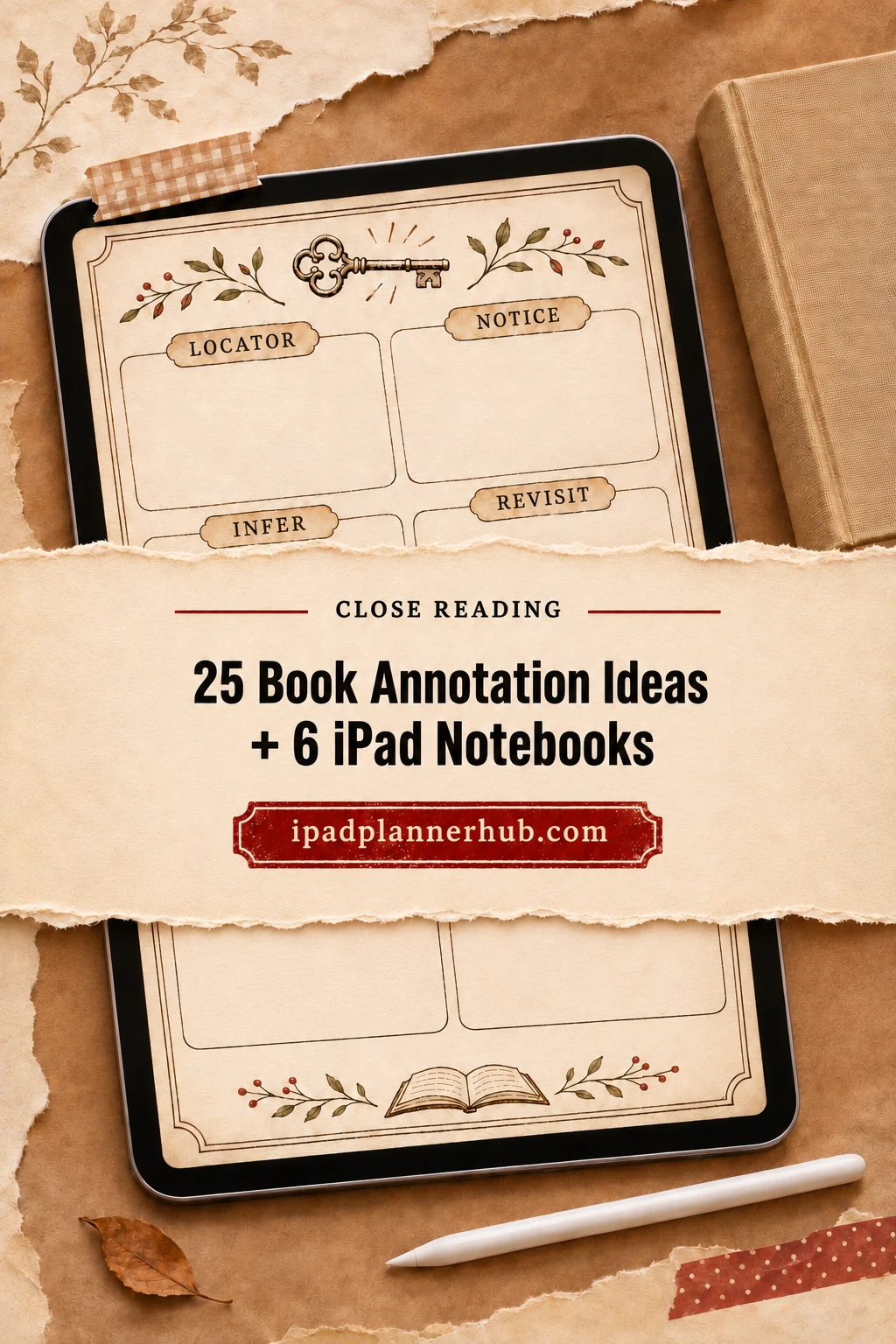
The suggested layout has four fields. Keep the locator small, give the observation its own line and leave the largest space for reasoning. An unanswered question is a valid stopping point; you can revisit it when another passage gives you something new.
- Locator: book title, edition or format, chapter and page or ebook location. Add a short scene cue if the numbering may change.
- Observation: what is actually on the page, such as a repeated word, a change of speaker or an unexplained action.
- Inference: what you think that detail might mean. Use tentative language when the passage leaves more than one possibility.
- Revisit: a later locator and a sentence saying whether your first reading still holds.
For example, imagine a fictional scene where a visitor keeps a key hidden while insisting that everyone can leave. The observation is the concealed key, the inference might be control disguised as hospitality, and the next question is who can actually open the door. This invented example is a model for the fields, not a quotation from a published book.
What to annotate in a book for school or for fun
For school, begin with the question your assignment asks, then collect passages that help you answer it. Note a character’s decision, a repeated image or the evidence behind an argument, and explain how each detail supports or challenges your answer. Record page numbers beside short quotes so you can return to the full context when you write.
When deciding what to annotate in a book for fun, follow the moments you enjoy or find interesting: a favorite exchange, a surprising turn in the story or a sentence you love. Add why it caught your attention instead of only saving the words. Try creative doodles of a scene or symbol, then write a caption connecting the drawing to its passage.
Book annotation examples that connect a mark to a thought
Using the invented hidden-key scene above, a school note might say, “The visitor controls access to the door, which challenges the claim that everyone can leave.” A personal note might say, “I expected a warm welcome, but the hidden key made this room feel threatening.” Both entries explain a reaction to a specific detail; at the end of the story, you can revisit whether that first impression still fits.
Keep a small annotation kit beside your iPad journal
For a paper book, you can keep a pencil, your favorite pens and sticky notes in one pouch; use annotation tabs to mark passages you want to discuss in the digital companion. If you want the book to stay unmarked, write on a separate note and put the passage locator in your journal. Underlining or a highlight can identify the words, while the journal holds your explanation of why they matter.
For the companion itself, use a page in your iPad note-taking app with room for the four fields above. If you choose one of the PDF notebooks below, put the book title and edition on its opening page and keep passage notes together. You do not need a decorative kit to begin; the benefits of this setup come from connecting a passage to a thought you can find again.
25 book annotation journal ideas, grouped by what you notice
Choose one prompt that matches a passage in front of you. The groups are menus, not a checklist to complete for every book. Add the four-field trail to each entry so a page about imagery still leads back to the exact scene that prompted it.
Catch a detail before it disappears
- 1A word that changes the temperature
Record the locator and one striking word, then describe the feeling created by that particular choice. Try a plainer substitute in your own sentence. Ask what disappears when the original word is removed, and revisit if the word occurs in a different mood later. - 2A silence with a clear boundary
Note the question someone avoids or the moment a narrator skips. Separate the missing information from your theory about it. Leave a line for a later passage that either fills the silence or makes the omission more deliberate. - 3An object that receives unusual attention
Name the object and list only the details the passage gives it. Ask why it occupies so much space here. A key, cup or coat does not automatically symbolize anything; collect another appearance before building a larger interpretation. - 4A sentence that interrupts the rhythm
Mark a short sentence after a long description, or a long sentence after clipped dialogue. Describe the shift before explaining its effect. Return to the surrounding paragraph to decide whether the interruption stresses an action, a thought or a change in pace. - 5A pronoun with uncertain ownership
Write the locator and identify two possible referents for an ambiguous pronoun. Follow the nearby sentences for clues. If the uncertainty remains, keep both readings rather than silently choosing the one that makes the plot easiest to explain.
Follow a pattern across passages
- 6A repeated image with a changed role
Place two locators beside the same image, such as a window described first as an escape and later as a barrier. Record what changes between appearances. Your inference should explain that change, rather than merely announce that the image repeats. - 7A setting that answers a character
Pair a description of a room or landscape with a nearby action. Ask whether the setting supports, resists or complicates the character’s mood. Keep the descriptive evidence separate from the emotion you infer. - 8A verb pattern for one character
Collect a small cluster of action verbs attached to the same person. Are they waiting, taking, watching or refusing? Compare a later scene for an exception. The exception may tell you more than a long list of similar verbs. - 9A motif with a counterexample
Start a motif page with two supporting passages, then deliberately search for one passage that does not fit. Write how the counterexample narrows your claim. This page is useful when a neat theory starts explaining too much. - 10Two scenes built around the same choice
Pair the locators of two decisions that look similar. Compare who has information, who holds power and what each person risks. Revisit your first judgment after the second scene instead of flattening both choices into the same lesson.
Test a voice or an argument
- 11A statement beside a conflicting action
Put what a character says next to what they do in the same scene. Describe the mismatch without immediately calling it dishonesty. Your inference can consider fear, limited knowledge or a change of intention, then seek another passage to test it. - 12Narrator knowledge versus reader knowledge
List what the narrator can know at this point and what you have inferred independently. Add the relevant locators. This prevents a later revelation from being treated as obvious evidence available to everyone from the start. - 13A claim with a hidden condition
For nonfiction, paraphrase one claim and write the condition under which it seems to hold. Look at the author’s example for that condition. Mark any broader version as your extension, not something the author has necessarily established. - 14Evidence and the bridge to a conclusion
Write the evidence in one field and the conclusion in another. In between, add the reasoning needed to connect them. If you cannot identify that bridge in the passage, leave a question for a later section rather than inventing the author’s explanation. - 15A definition that shifts
Record how a key term is used in an early passage and again later. Compare the scope of the two uses. A shift might be purposeful or unresolved; state what changed before deciding whether it strengthens the argument or causes confusion.
Keep questions precise
- 16A question with a return address
Replace a broad note like “I am confused” with a question tied to a locator: why does the speaker change the subject immediately after this name? Add what evidence would help. A later answer belongs beneath the original question, not on an unrelated page. - 17Two explanations for one detail
Divide a page into reading A and reading B. Give each explanation its strongest evidence from the same passage. Add a third space for what would distinguish them, so uncertainty becomes a specific reading task rather than a vague feeling. - 18A prediction with a reason
Write a prediction only when a concrete detail prompts it. Include the clue, the locator and your confidence in ordinary words. After the event, compare your reasoning with what happened; a wrong prediction can still reveal a meaningful pattern. - 19An unfamiliar reference in context
Write what the surrounding sentence lets you infer before looking anything up. If you consult a reference source, record its title or URL separately. Then return to the book and explain whether the additional context changes your reading of this particular passage. - 20A feeling attached to a technique
Begin with your reaction, then locate the feature that may have produced it: a withheld name, a repeated sound or an abrupt cut. Keep your emotional response as yours. The page asks how the writing worked for you, not how every reader must feel.
Revisit without erasing your earlier reading
- 21A first impression with a later correction
Preserve the original note, then add a later locator and a correction underneath. Explain which new detail changed your mind. Avoid rewriting the first entry to sound as if you understood the whole book from the beginning. - 22A clue that looks different in hindsight
Return to an early detail after a revelation. Write what the detail suggested then and what it suggests now. Keep the later knowledge clearly labeled so your rereading does not erase the uncertainty of the first encounter. - 23A provisional theme statement
Write one narrow sentence about a pattern, supported by two locators. Add a limit: which scene does the sentence fail to explain? Revise the statement when you find a better fit instead of collecting more passages only to defend it. - 24A linked pair of unresolved notes
Connect two entries that ask related questions but remain unanswered. Add the entry numbers and a sentence explaining the relationship. This is more useful than a decorative arrow because it tells your future self why the connection mattered. - 25A rereading experiment
Pick one earlier inference and reread only the passage and its immediate surroundings. Write a competing explanation before choosing between them. Finish with what changed, what stayed uncertain and the next locator you would need to examine.
A small annotation key that leaves room for thought
For a simple annotation key, start with three symbols: ? for an open question, ↔ for a connection and R for a revision. Write the meaning on the first page. A book annotation color key can add color to these categories, but keep the symbol or word too, so the meaning survives a change of pen color.
- For fiction: start with a detail, an action or a pattern in the language. Add a theory only after the observation.
- For nonfiction: start with a claim, a definition or the evidence used to support an argument. Keep your own extension labeled.
- For school: follow the assignment’s citation and annotation requirements first. These prompts are optional structures, not a replacement for the rubric.
- For fun: one question about a scene you care about is enough. Skip a category that makes the reading feel like administration.
Move the system onto an iPad page
The layout can live in a blank notebook you already own. If you want a reusable starting structure, the notebook options below include lined, two-column, Cornell and dark paper. Use the prompts above to build your own passage pages.
Build one reusable passage page
- 1Make a master page. Add the four field labels to a blank or lined page in your annotation app. Keep the right edge clear of any notebook navigation tabs.
- 2Test it with one passage. Write a locator and a short observation at your normal handwriting size. Increase the reasoning space if you have to squeeze your interpretation into the margin.
- 3Use entry numbers. Give the note a simple identifier such as A01. Put that identifier in an index beside its locator; do not assume handwritten references become automatic links.
- 4Keep revisions visible. Leave a few lines below the inference or add a continuation page. Preserve the earlier text so a change in interpretation remains traceable.
- 5Expand only when useful. Start with a chronological sequence. Add a separate motif or questions section when you actually need to retrieve several related entries.
For app-level planning habits, see my Goodnotes tips. For book ratings, reading logs and broader reading memories, the digital reading journal guide covers a different job. This companion is for following evidence inside the text.
Six optional iPad notebooks for your annotation pages
Choose the paper structure before the cover design. Two-column paper suits competing readings; half-lined paper gives a small diagram room to breathe; a plain lined sequence suits a reader who wants fewer decisions. App purchases, if needed, are separate from the notebook files.
TL;DR: All six are optional general notebooks. They provide writing surfaces for the prompts above, not ready-made book annotation pages. Start with paper you already have; choose a notebook only if its page structure helps your notes.
Quick Picks
- Best for open observation space: Watercolor Hyperlinked Digital Notebook
- Best for parallel readings: Digital Notebook
- Best for a five-part system: Digital Notebook 5 Hyperlinked Tabs
- Best for varied page structures: Digital Notebook 5 Hyperlinked Tab
- Best for a dark paper option: Dark Mode Digital Notebook – Gold Theme
- Best for simple lined notes: DaisyNotes | Digital Notebook | Purple
- Watercolor Hyperlinked Digital Notebook – Best for open observation space
- Digital Notebook – Best for parallel readings
- Digital Notebook 5 Hyperlinked Tabs – Best for a five-part system
- Digital Notebook 5 Hyperlinked Tab – Best for varied page structures
- Dark Mode Digital Notebook – Gold Theme – Best for a dark paper option
- DaisyNotes | Digital Notebook | Purple – Best for simple lined notes
Best for open observation space
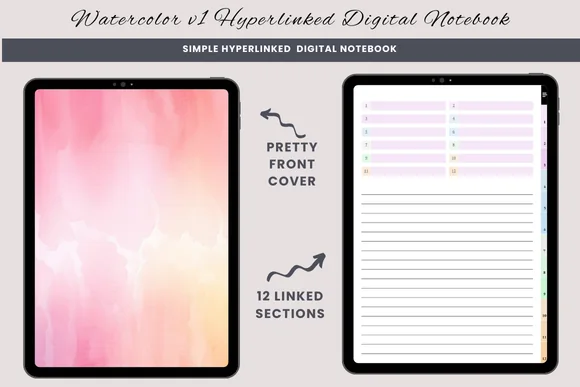
1. Watercolor Hyperlinked Digital Notebook
Orientation: PortraitLayouts: 12 sections; 3 paper typesFormat: PDF
Best for: a short observation above a longer interpretation. Designed by daysfilledwithjoy.
- One hyperlinked PDF
- 12 sections
- Lined, blank and half-lined paper
The half-lined page is the useful detail here: leave the open half for a tiny motif map, then explain the pattern below. Use it when a note begins as a sketch and becomes a paragraph. You will need to add every annotation heading yourself.
Best for parallel readings
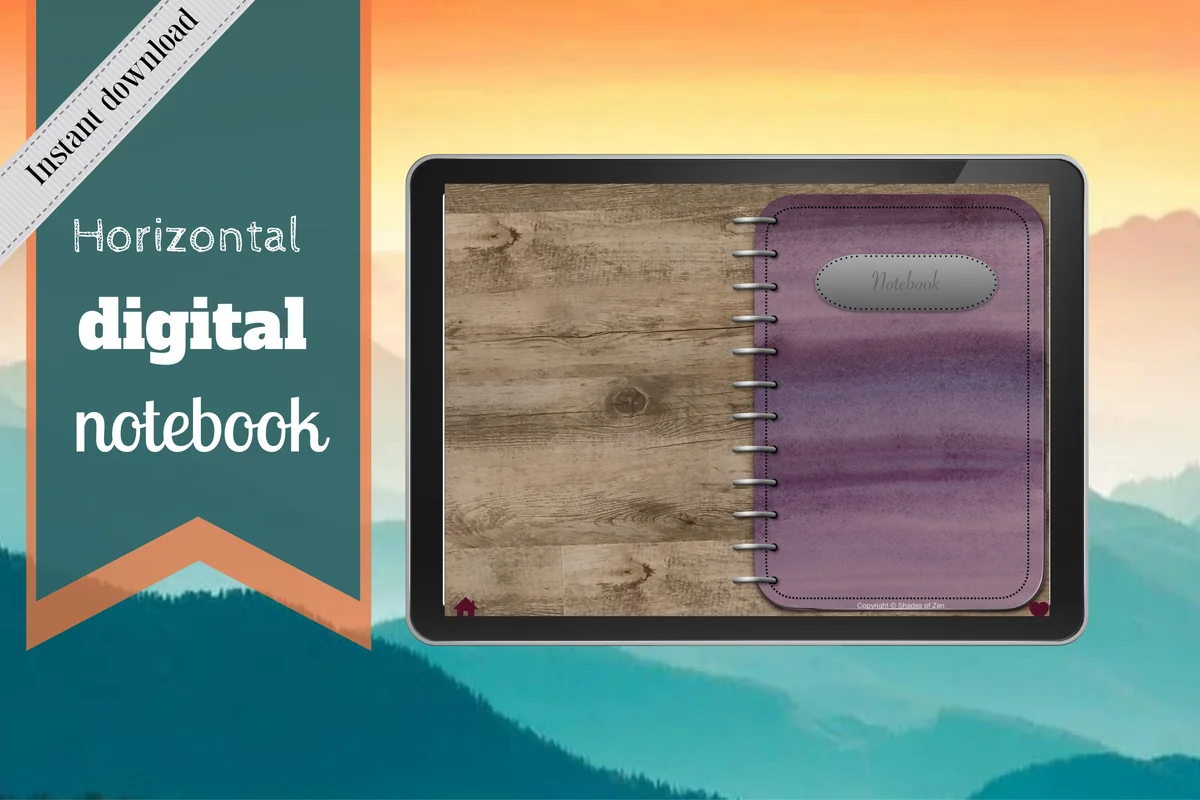
2. Digital Notebook
Orientation: LandscapeLayouts: 12 sections; 16 templatesFormat: PDF
Best for: evidence and competing interpretations side by side. Designed by Shades of Zen.
- 12 linked sections
- 16 note templates
- Two-column and Cornell options
The two-column template gives an observation and a competing explanation separate places to live. Twelve sections also allow one book per section for a small ongoing library. The purple binder takes up visual space; choose it for organization rather than a borderless writing surface.
Best for a five-part system
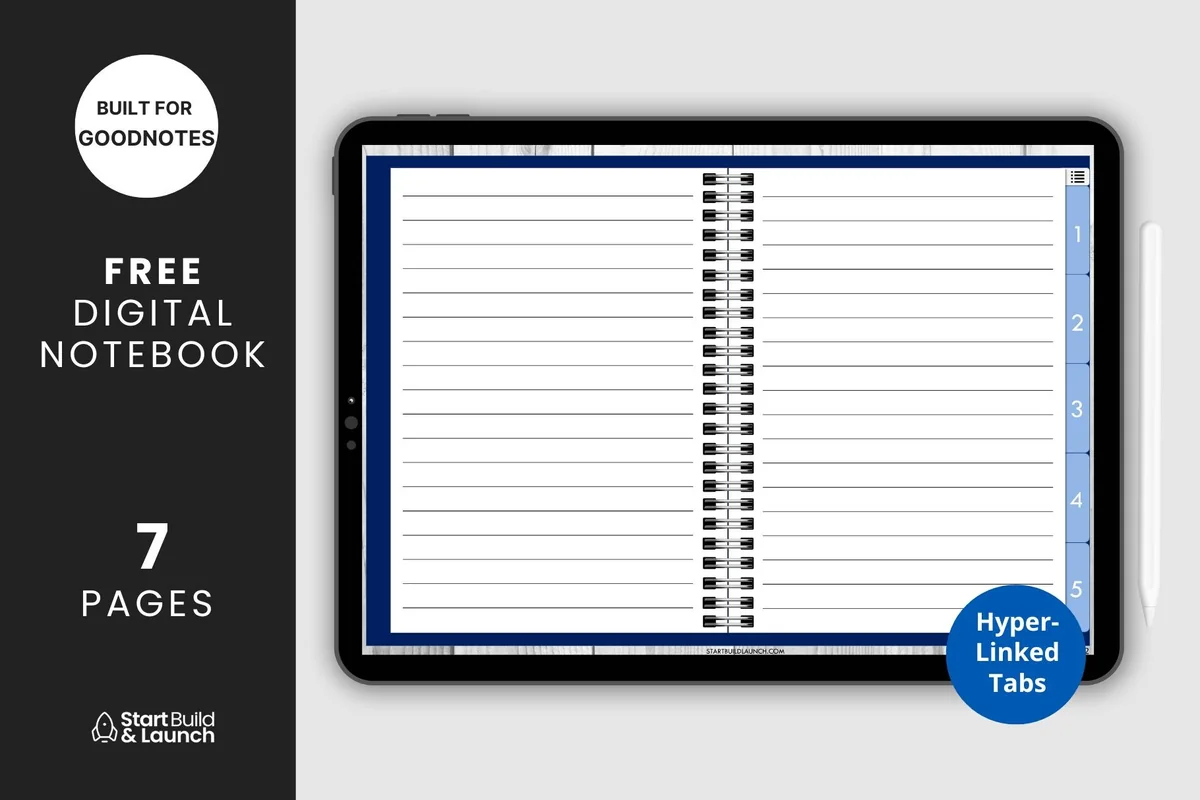
3. Digital Notebook 5 Hyperlinked Tabs
Orientation: LandscapeLayouts: 5 sections; 5 paper typesFormat: PDF
Best for: a compact notebook organized by note function. Designed by aviswilliams.
- Blank cover and index
- Five linked sections
- Blank, lined, dotted, graph and Cornell pages
Five sections are enough for an index, passage notes, patterns, open questions and revisions. The Cornell page can keep a locator in the narrow column and reasoning in the main area. This blue binder is a general notebook, so the close-reading system is your own addition.
Best for varied page structures
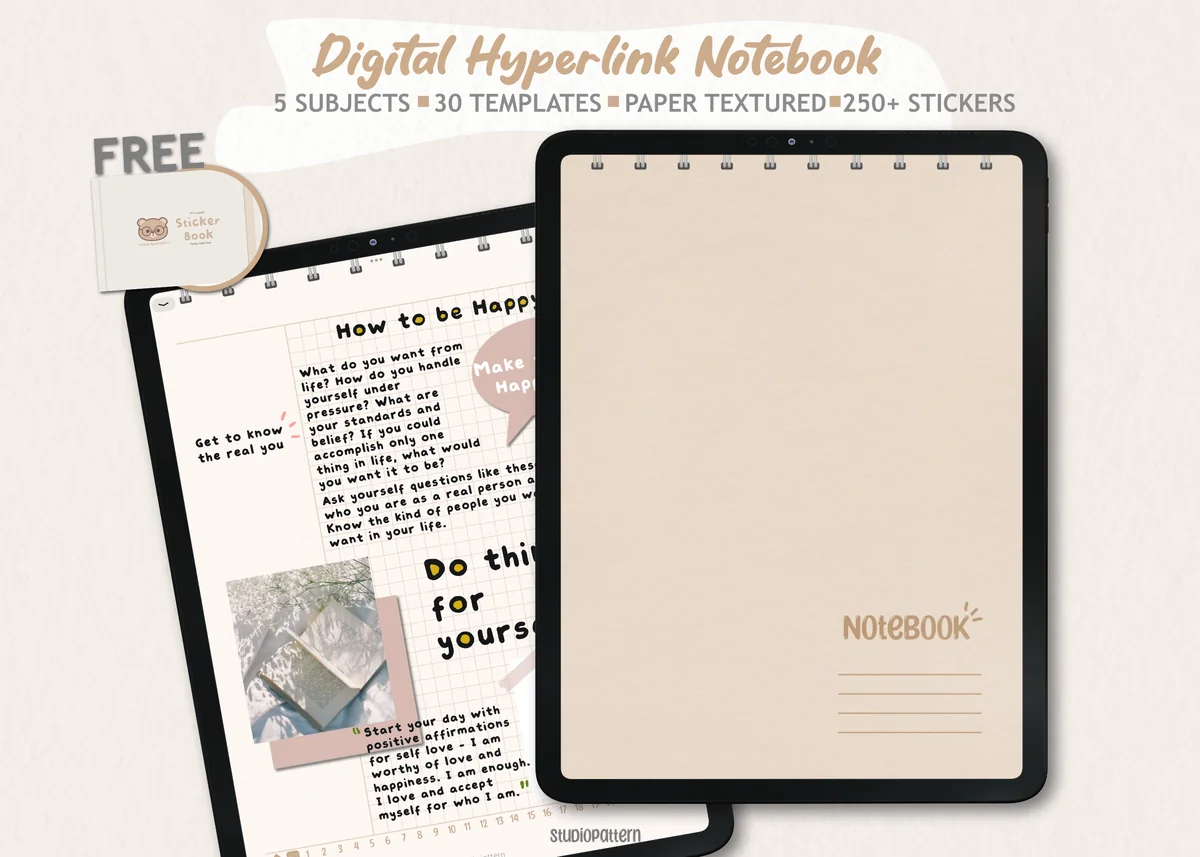
4. Digital Notebook 5 Hyperlinked Tab
Orientation: PortraitLayouts: 5 sections; 30 templatesFormat: PDF
Best for: switching between prose, grids and diagrams. Designed by studiopattern.
- Five linked sections
- 30 paper templates
- 250+ PNG stickers and a Goodnotes sticker book
Thirty templates offer more room to change the shape of a note as your question changes. The neutral textured paper works for both handwritten paragraphs and relationship diagrams. The general sticker bonus is optional decoration; it does not supply literary analysis prompts.
Best for a dark paper option
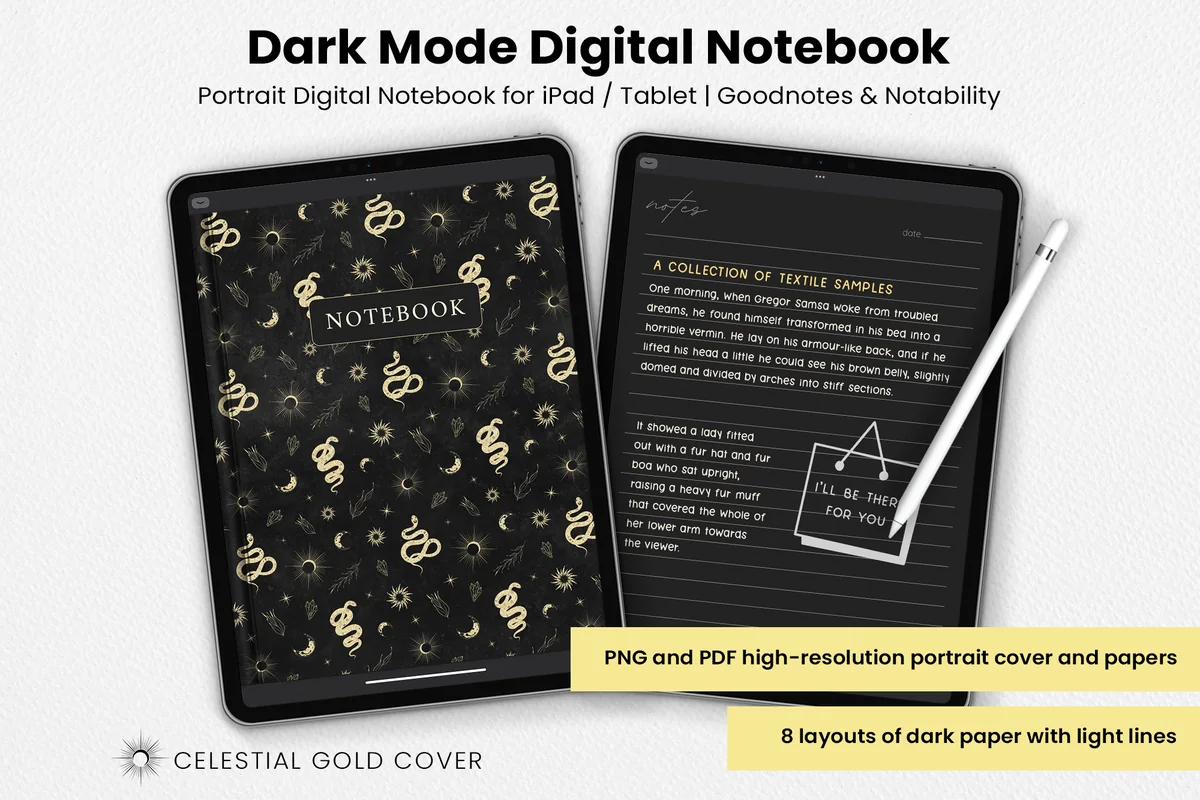
5. Dark Mode Digital Notebook – Gold Theme
Orientation: PortraitLayouts: 8 dark paper layoutsFormat: PNG and PDF
Best for: writing a compact evidence trail on a dark background. Designed by catsquills.
- Portrait notebook for Goodnotes or Notability
- Eight dark paper layouts including columns and notes
- PNG and PDF files
The columns layout is the reason to consider this alternative: one column can hold a locator while the other holds the observation. Choose an ink color you can read clearly against the dark paper. Linked sections are not stated, and the habit-tracker and to-do sheets are not needed for this reading system.
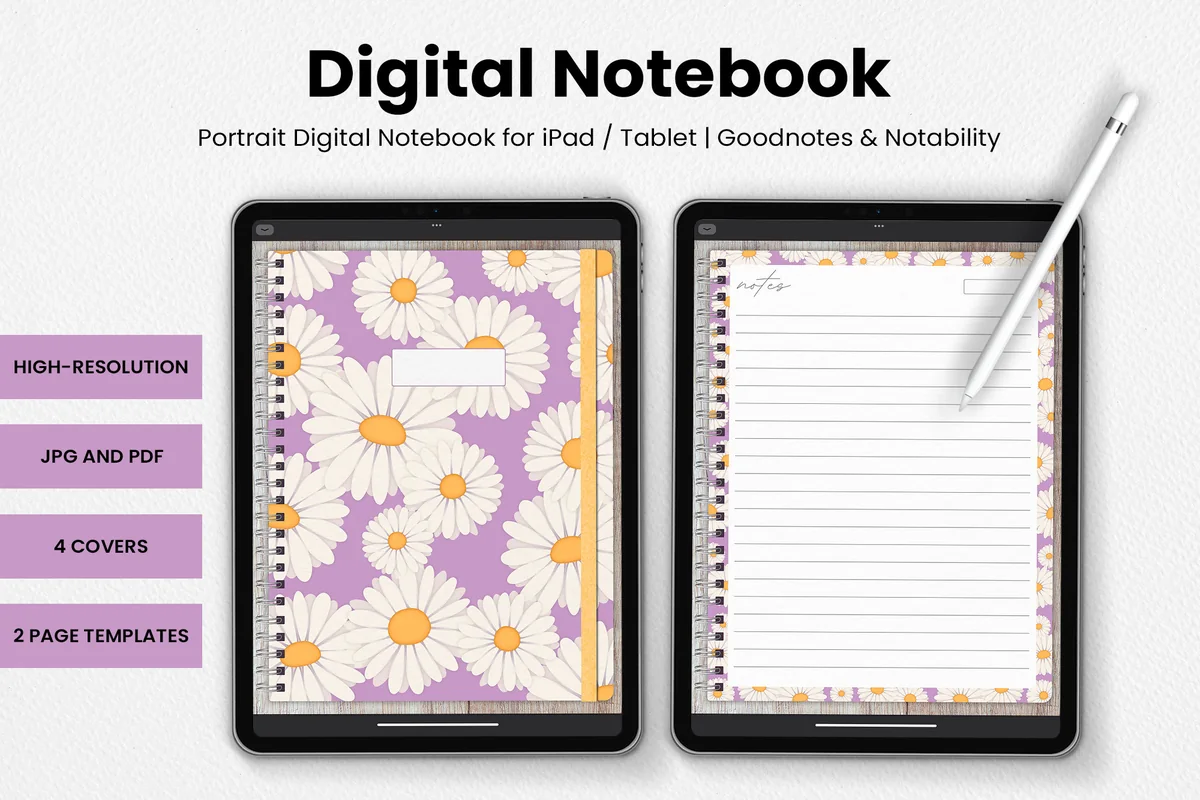
Best for simple lined notes
6. DaisyNotes | Digital Notebook | Purple
Orientation: PortraitLayouts: 4 covers; 2 page templatesFormat: JPG and PDF
Best for: one continuous passage-note sequence. Designed by catsquills.
- Four floral covers
- Two page templates
- JPG and PDF files for Goodnotes or Notability
DaisyNotes suits a reader who wants a running notebook rather than many categories. The lined page leaves space for a locator, a few sentences and a revision underneath. Its floral edge and wood-textured background are visible in the previews; hyperlinks and a ready-made annotation index are not promised.
Quick Comparison
| Notebook | Orientation | Inside | Annotation use |
|---|---|---|---|
| 1. Watercolor Hyperlinked Digital Notebook | Portrait | 12 sections; 3 paper types | Half-lined observation pages |
| 2. Digital Notebook | Landscape | 12 sections; 16 templates | Two-column comparisons |
| 3. Digital Notebook 5 Hyperlinked Tabs | Landscape | 5 sections; 5 paper types | Cornell evidence notes |
| 4. Digital Notebook 5 Hyperlinked Tab | Portrait | 5 sections; 30 templates | Mixed note structures |
| 5. Dark Mode Digital Notebook – Gold Theme | Portrait | 8 dark paper layouts | Columns on dark paper |
| 6. DaisyNotes | Digital Notebook | Purple | Portrait | 4 covers; 2 page templates | Running lined entries |
Keep the notebook useful after the first few entries
A notebook becomes difficult to revisit when every page has a different locator style or an unexplained color. Tidy the index before redesigning the page. The goal is to find an earlier thought and understand why you wrote it.
- Cannot find a passage? Add the chapter and a brief scene cue beside the page or ebook location. Keep the edition or format on the book’s index page.
- Too many categories? Merge categories that lead to the same kind of note. Keep an open-question label separate only if you revisit those questions.
- Notes becoming plot summaries? Replace the recap with one detail and a sentence explaining why it matters at that point.
- Every interpretation sounds certain? Add an alternative explanation and name the evidence that would change your mind.
- Preparing to discuss the book? Select a few passage trails to bring into the book club journal workflow, where the focus shifts to shared discussion.
FAQ: Book annotation journal questions
How does a passage become a useful journal entry?
Start with a locator, an observation and a tentative explanation. Add a later revision when another passage changes your reading. A repeated image, an unexplained action or a claim with a missing condition gives you something specific to investigate.
Do I need to write in the book itself?
No. Keep the companion beside a paper book or ebook and record locators in the journal. This also works when you want to keep the book’s pages unchanged. Your journal needs enough detail to return to the passage without copying whole pages.
What are five examples of annotation?
Five starting examples are a word-choice note, a question about an omission, a repeated-image comparison, a claim-and-evidence note and a revised interpretation. Each becomes more useful when it names a passage and explains your reasoning rather than only marking a category.
How many annotation colors should I use?
Start with three categories, with a symbol or written label for each. You can use fewer. Add another color only when it represents a distinction you will use when reviewing the notebook; there is no required universal color code.
Are these notebooks ready-made annotation journals?
These digital notebooks offer different paper layouts and file formats. To follow the method above, add the four fields, an index and the prompts you want to use. Choose the page structure that suits your notes.
Begin with one passage you want to understand
The most useful book annotation journal ideas give your curiosity a place to continue. Choose one of the 25 prompts, write a precise observation and leave room for a later correction. A plain page can do that job; the six notebooks are optional ways to organize the trail.
You May Also Like
Some links here are affiliate links: a qualifying purchase can earn me a commission while your price stays the same. See the affiliate disclosure.