The word looked familiar in your notes, but it vanished when someone asked you a simple question. These language learning journal ideas connect a page of writing to something you want to say, understand or ask. You can build them on your iPad without turning every practice session into another vocabulary-copying exercise.

A language journal can hold the gap between recognizing a phrase and using it with confidence. It does not need to contain every new word from a lesson. I would give priority to language tied to your actual conversations: explaining a preference, asking for help or describing something that happened. Keep uncertain wording marked for checking, because a neat page is not evidence that a sentence is correct.
Choose a Starting Point for These Language Learning Journal Ideas
Choose one language and one near-term situation, such as discussing a weekend plan. Begin with a page for what you want to say and a second page for what happened when you tried. Write examples at your current level, with help from a teacher or trustworthy reference when needed. The prompts below describe page structures; any example in English is an intention to express in your target language, not a translation you must memorize.
Prepare Language You Might Actually Say
- 1Situation vocabulary
Pick a situation small enough to picture, such as asking a neighbor about a parcel. Give the page three columns: meaning needed, useful expression and your own sentence. Include the question you may hear in reply, not just the words you hope to say.
Limit the first entry to a handful of expressions. A compact page about one situation is easier to put into use than a long themed list whose words never appear together in an actual exchange.
- 2Phrase alternatives
Write one intention at the top, such as declining an invitation kindly. Collect two or three ways to express it, then note the tone and situation for each. Ask a teacher which version fits a colleague versus a close friend.
Add your own short reply underneath rather than memorizing isolated alternatives. This page is useful when you keep reaching for one familiar phrase even though it sounds too abrupt, too formal or simply repetitive in the conversation you want to have.
- 3Conversation preparation
Prepare the first few turns of a likely conversation. Include an opening, two things you want to ask and a clarification request in case you miss the answer. For a conversation about a class, leave space for details such as the day and meeting place.
Keep the wording flexible rather than scripting the other person’s entire response. The page should help you enter an exchange and recover from confusion, while leaving room for the conversation to go somewhere you did not predict.
- 4Conversation follow-up
After an exchange, record one moment when you could not express what you meant. Write the intended meaning first, then build a better version with an appropriate reference or teacher. Add a follow-up question you could ask next time.
For example, you may have named a food but struggled to explain why you preferred it. Keep the note about language rather than judging your whole performance. One repaired moment gives the next conversation a clearer starting point than a general note to improve speaking.
- 5Error and correction
Use a short entry with your original sentence, a checked correction and a new sentence of your own. Underline the exact part that changed and explain it in plain language. If you corrected a way of expressing a past event, make the new example about a different event so you have to use the pattern again.
Keep a question mark beside anything unverified. The goal is a usable repair, rather than a growing list of mistakes with no connection to future speech.
Listen, Read and Notice the Gaps
- 6Listening excerpt
Choose a very short section of audio and record its title and timestamp. Before looking at supporting text, write the gist and the part you are unsure about. Listen again, then add what changed in your understanding.
A page might distinguish whether a speaker accepted a plan or merely acknowledged hearing it. Avoid copying a full transcript. A few words and a meaning note leave room to focus on the listening problem instead of making a decorative archive of somebody else’s speech.
- 7Words heard in context
Save a word together with the situation in which you heard it. Record the source, the surrounding meaning and one new sentence connected to your life. If a word appeared during a discussion about changing plans, do not strip away that context and file it only under verbs.
Add a note about the person or thing it described without including private details. Later, check whether your new sentence uses the word in a comparable way, especially when a familiar translation seems too broad.
- 8Reading response
After a short article or story, write a response in the language you are learning. Begin with what happened or what the author argued, then add your opinion and one reason. Keep a source line and mark language you want checked.
A beginner might manage three sentences about a character’s decision; a more advanced learner can add a qualification. This page asks you to react to meaning, rather than collecting every unfamiliar word and never saying anything about the text as a whole.
- 9Pronunciation question
Give a troublesome word its own question box. Record the spelling, an audio source or lesson location and what you find difficult, such as hearing where one syllable ends. Ask a teacher or consult a suitable pronunciation reference instead of inventing a spelling-based sound guide.
Add the answer in a different color after checking. If useful, note a word for comparison that your teacher supplies. The page holds a precise question, so the next practice session has something more actionable than improve my accent.
- 10Grammar in my life
Take one pattern from a lesson and use it to describe two situations you can imagine yourself discussing. If the lesson concerns future plans, write about a coming meal and a weekend visit. Record the lesson reference and a short explanation of why the form fits.
Then add a question using the same pattern. Keep the rule narrow, and check exceptions rather than expanding a single example into a universal formula. Personal examples make the page relevant without requiring you to write private information.
Make Meaning More Specific
- 11Polite versus casual
Compare two ways of making the same request in different relationships. Give each version a setting, an intended listener and a note about tone, checked with a teacher or reference. For instance, asking a close friend to repeat something may sound different from asking a customer to do so.
Do not label one form polite and another rude without context. The purpose is to notice choices, including situations where directness, familiarity or formality carries a meaning that a literal translation misses.
- 12False-friend warning
Create a warning card for a word that resembles one in a language you already know but carries a different meaning. Put your initial guess beside the verified meaning, followed by a sentence that makes the difference clear. Include the dictionary or lesson reference you checked.
Add a caution if the meaning changes by region or context. Avoid collecting entertaining examples with no practical use; choose a word that has actually interrupted your reading, listening or attempt to express an everyday idea.
- 13Picture description
Use a photograph you took or have permission to use. Write five short sentences: what is visible, where things are, what someone may be doing, one detail and one question. Mark guesses as guesses.
A kitchen photo could support descriptions of objects and positions without needing an elaborate story. Check one sentence carefully rather than trying to correct everything at once. On an iPad, leave the picture large enough to inspect, with writing beside or below it instead of covering important details.
- 14Mini-dialogue
Draft a short exchange for one practical task, such as changing an appointment. Give each turn a purpose: explain the problem, ask about an alternative, clarify the time and close the exchange. Keep vocabulary within reach and add one possible unexpected reply.
Read the lines aloud as practice, then revise anything you would struggle to say. A mini-dialogue works best as rehearsal for a situation; it should not imply that real people will follow your script or that one wording fits every relationship.
- 15Retell a small event
Describe a small event in a few sentences, using a sequence you can follow without inventing a dramatic story. Note where you were, what happened and what changed. For example, a missed bus gives you a beginning, a problem and a result.
Add one detail that would help a listener picture it. Keep the first version, then rewrite a single sentence after checking it. That small revision makes your page a record of language development rather than a demand for a polished daily essay.
Turn Feedback into Your Own Sentences
- 16Question bank
Make a bank of questions you would sincerely like to ask people. Organize them around a setting, such as meeting someone at a hobby class, and leave room for possible follow-up questions. Include a note about whether a question may feel too personal for a first conversation.
Check the phrasing instead of translating word by word. A useful page might contain only six questions, each with a reason you want to ask it, rather than fifty prompts that you would never naturally bring up.
- 17Answer expansion
Start with a short answer you already know how to give, then expand it with a reason and an example. An answer about liking a town might grow into a sentence about its park and a specific activity there. Write the versions one below the other so you can see exactly what you added.
Ask whether the longer version still sounds natural. The purpose is to develop an answer you can use, not to replace clear sentences with elaborate wording that is harder to say.
- 18Words I actually used
Record an expression after you have genuinely used it, with a brief note about the situation. Write what you meant, whether the other person seemed to understand and what you might adjust. Understanding a reply is not proof that every word was correct, so keep any uncertainty visible.
If you have not used the expression yet, leave that row empty. This page helps distinguish language you have encountered from language you have attempted to bring into an exchange, without turning conversations into a scoring exercise.
- 19Resource notes
Give a resource a small note instead of adding it to an endless list. Record the lesson or episode, the language task it supports and one thing to try afterward. A video about ordering food might lead to practicing a clarification question, rather than watching another five videos.
Include the timestamp or lesson title so you can return to the relevant section. When the resource no longer fits your level or needs, say why; saving its name does not obligate you to finish it.
- 20Teacher feedback
Bring one specific piece of teacher feedback onto a page you can act on. Include your original wording, the teacher’s suggestion and a new example for the next lesson. Add a question if you do not understand why the change helps.
Keep comments about accuracy separate from suggestions about style or naturalness. A teacher may accept several versions depending on context. One carefully understood correction can be more useful than copying an entire marked assignment and treating every change as a rule for all situations.
Connect Practice Across Several Sessions
- 21Before-and-after sample
Repeat a small task after some time, such as describing the same photograph or introducing a favorite activity. Date both samples and keep the prompt unchanged so you can make a meaningful comparison. Note differences in clarity, range or questions that remain; do not judge progress only by length.
If you revised the first sample with help, label that version separately. This page can reveal what changed in your writing, but it does not provide an objective proficiency score or measure every part of language ability.
- 22Personal phrasebook
Build a phrasebook around your interests and responsibilities. Someone who gardens may need ways to describe plant care; someone joining a book club may need ways to disagree gently. For each phrase, add the meaning, a checked example and the situation where you expect to use it.
Keep space for an alternative if the first version sounds too formal. The value comes from selection: a small set tied to your life can guide practice better than copying a generic list that has no obvious destination.
- 23Practice session plan
Set one communicative goal for a session, with the resource and time available beside it. For example, practice explaining why you want to move an appointment, using a lesson you already have. Write a short output you can attempt at the end, such as a four-turn exchange.
Keep the plan modest enough to leave time for actually using the language. Broader schedules belong in a study planner; this page exists to make the next period of practice specific rather than fill every hour of the week.
- 24Practice session result
Close a session with what you attempted, one usable sentence and a question still open. If you planned appointment practice but spent the time understanding a reply, record that honestly. Add the place to resume, such as a lesson timestamp or a sentence that needs feedback.
Avoid using the page only to count minutes. A short result note should help you reconnect with the language next time, while allowing the session to have been useful even when it did not follow the original plan.
- 25Monthly language snapshot
At the end of a month or another convenient interval, choose a situation you can now handle more clearly. Include a short sample, the page that helped and one remaining difficulty. Perhaps you can ask for a different time but still struggle to understand rapid alternatives.
Turn that difficulty into the next small speaking or listening task. Keep the reflection grounded in examples rather than claims of fluency. You are collecting evidence of what you can attempt, not setting a deadline for mastering an entire language.
Give Your Sentences Enough Writing Space
Use two columns when you need to separate an attempt from a correction or a phrase from its meaning. Choose lined space for retelling and reading responses. A blank page works for a photograph with a caption; a calendar can hold a practice reminder, but it cannot supply the conversation content. Start with the layout that gives your sentences enough room. You can add the task headings yourself instead of waiting for a specialist language template.
When your listening material is a podcast, keep the language exercise separate from the record of where you stopped. The podcast journal layouts organize episode order and return cues, leaving your practice page free for phrases, questions and checked corrections.
If lessons regularly get lost among other commitments, a student planner can give practice a place in the week. If you already have a schedule, a sectioned notebook offers more room for language examples. A compact decorated journal suits short reflections, provided its writing areas fit your handwriting. None of these alternatives is a language course, correction service or ready-made vocabulary database. Choose one only if it solves a real page or organization problem you have.
Three iPad Options for Practice Notes and Lesson Planning
TL;DR: Choose a student planner for lesson structure, a sectioned notebook for sentence comparisons, or a compact journal for short practice reflections. All three need your own language headings and examples.
Quick Picks
- Best for lesson structure: Simple Student Planner
- Best for phrase comparisons: Digital Notebook
- Best for brief practice reflections: Undated Cute Orange Bullet Journal
- Simple Student Planner – Best for lesson structure
- Digital Notebook – Best for phrase comparisons
- Undated Cute Orange Bullet Journal – Best for brief practice reflections
Best for lesson structure
1. Simple Student Planner
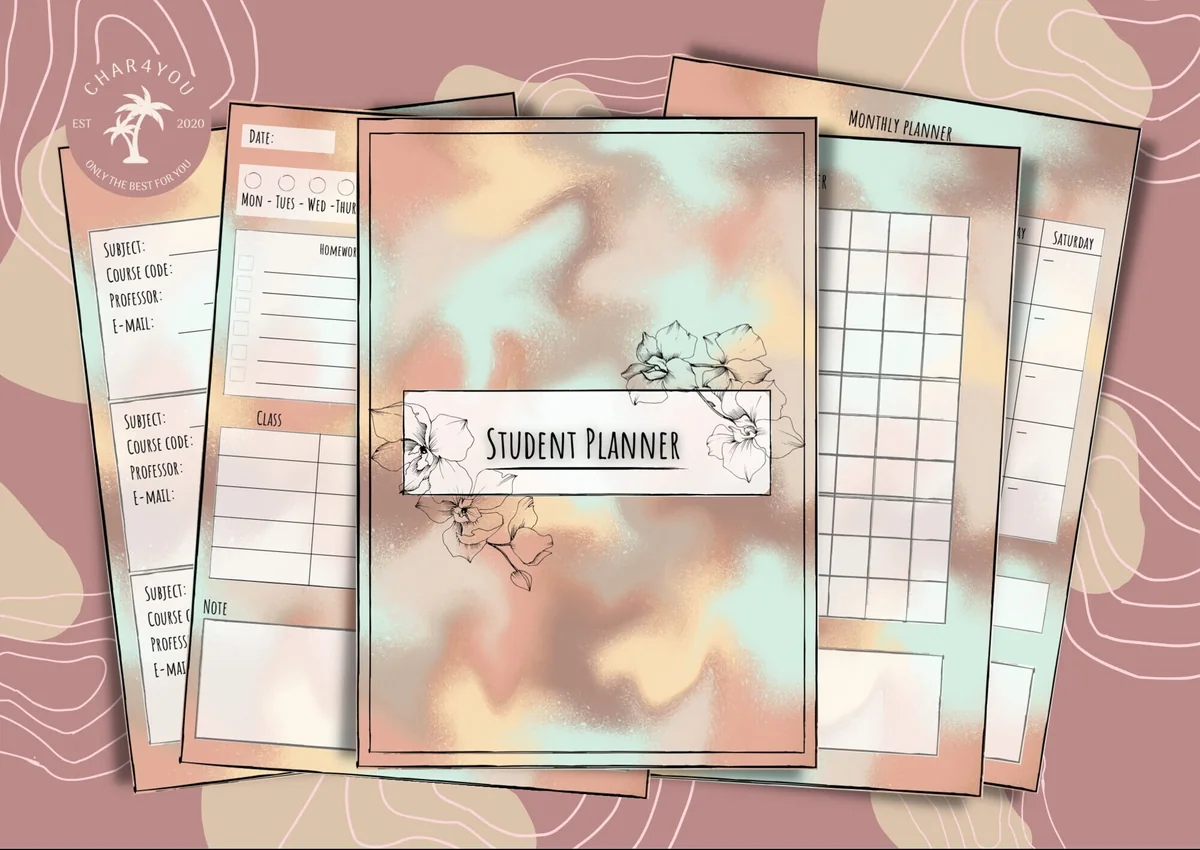
Layouts: Schedules, study tracker, lined and blank notes
Best for: giving language practice a place beside lesson notes. Designed by Char4You.
- PDF format compatible with GoodNotes
- Class schedules and a study tracker
- Lined and blank note pages
- Color and black-and-white options shown
Practice needs a place to happen before another page of phrases will help. This planner earns its place for the study tracker and schedules, with lined or blank notes available for the conversation prompts above. I would use its planning pages for lesson commitments and create the language headings myself. It is a general student planner, not a language course, vocabulary database or correction tool. Choose it for the page layouts; do not assume it has clickable navigation.

Best for phrase comparisons
2. Digital Notebook
Orientation: LandscapeLayouts: 16 note templates; 12 sections
Best for: separating attempts, corrections and follow-up questions. Designed by Shades of Zen.
- 12 sections with individual dividers
- 16 note templates, including lined, dot grid, two-column and Cornell options
- GoodNotes and PDF annotation apps named in the description
- Linked section tabs described and pictured
Two columns give an attempted sentence and a checked revision their own space. Other sections could hold conversation preparation or reading responses, without forcing them into a calendar. The variety of general note pages is the advantage, but you supply the target-language content and check it with an appropriate reference. I like this option when scheduling is already handled elsewhere. You add each correction and follow-up question yourself.
Best for brief practice reflections
3. Undated Cute Orange Bullet Journal
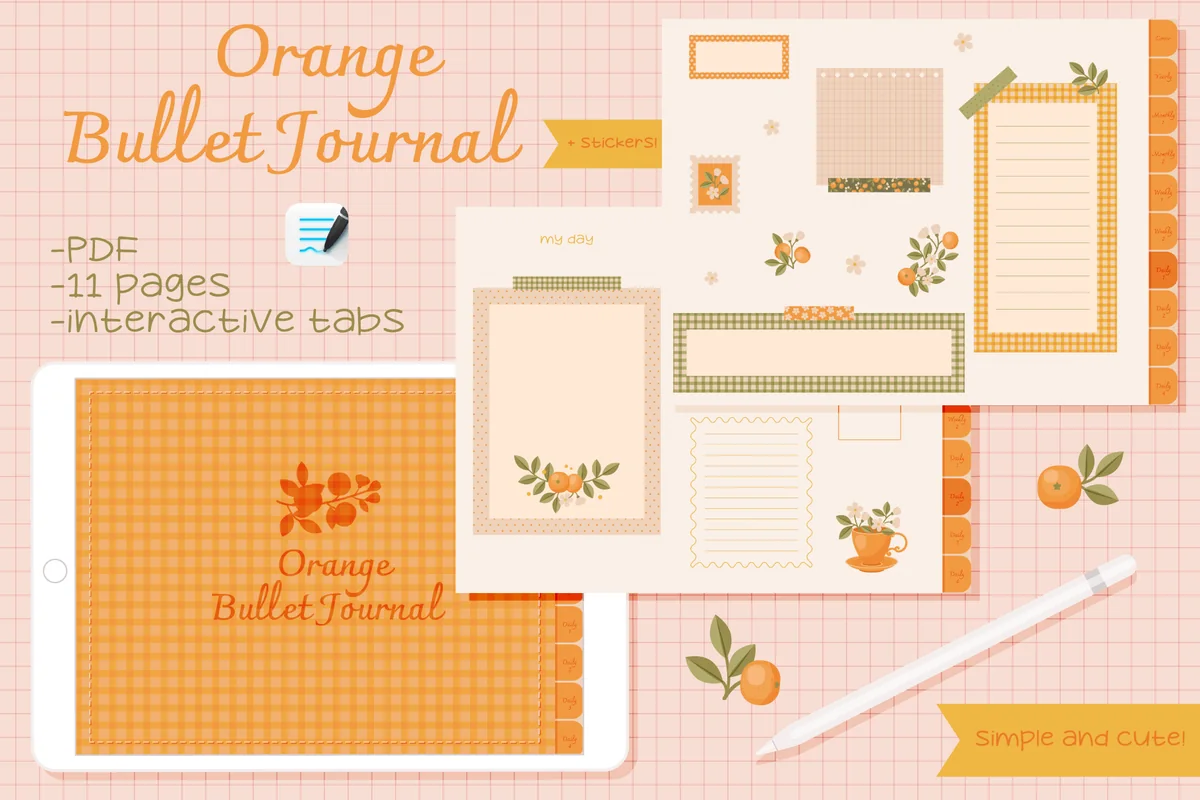
Layouts: Fill-in calendar and decorated writing framesDates: Undated
Best for: a few sentences and a fill-in practice calendar. Designed by digitaliya_studio.
- PDF journal with a GoodNotes import workflow
- Unfilled calendar and decorated note frames shown
- Stickers supplied in GoodNotes format
- Orange, cream and green design across the pictured pages
A few sentences about what you managed to say can fit the spirit of this small journal. The pictured calendar could hold reminders, while the frames can separate one phrase from a question for the next lesson. Longer dialogues will need more room than these decorated areas offer. Choose it for a compact visual record if that suits your writing; it supplies general pages and stickers, not ready-made language exercises. An existing blank page can do the same basic job.
Quick Comparison
| Option | Structure | Useful for | Keep in mind |
|---|---|---|---|
| 1. Simple Student Planner | Student planner | Schedules and study tracker | Language fields are your own |
| 2. Digital Notebook | Sectioned notebook | Two-column notes | No ready-made vocabulary system |
| 3. Undated Cute Orange Bullet Journal | Decorated journal | Short reflection frames | Small areas for handwriting |
FAQ: Language Learning Journal Ideas
Should I write only in the language I am learning?
Use as much of the language as you can manage meaningfully. A short note in your stronger language can preserve a question or explain a correction. You can revisit it later. Writing a few clear sentences is a reasonable start; filling a page with unchecked translations is not a requirement.
How many new words should go on one page?
Choose a manageable set connected to one situation, then give the words a use in sentences or questions. There is no fixed quota here. Stop when you have enough material for the practice you plan to do, and leave room for changes after you hear or read the words again.
Can a journal check pronunciation or correct my grammar?
These PDF notebooks hold your notes; they do not evaluate your language. Use a teacher, a suitable dictionary or another trustworthy reference to check uncertain examples. Record where a correction came from and keep unresolved questions visible instead of treating the page layout as a learning tool that verifies answers.
Where should I put a weekly study schedule?
Keep broader time planning separate from the content of your speaking and listening pages. Our study planner ideas cover ways to organize study tasks. Here, use a session plan only to connect the next available practice period with a specific language task.
Bring One Page into Your Next Exchange
Before the next lesson or conversation, choose a situation and write two things you want to express. Afterward, return to the same page and repair one gap. The strongest language learning journal ideas are the ones you can carry back into speech, reading or listening. Let the notebook support that movement instead of becoming another collection you feel obliged to complete.
You May Also Like
This article contains affiliate links. If you buy through them, I may earn a commission at no extra cost to you. Read the affiliate disclosure.