You remember a sentence from an essay, but the screenshot has disappeared between grocery lists and receipts. These commonplace book ideas give that thought a source, a place to live and a reason to revisit it. The aim is a notebook that helps you think, rather than a collection that only grows.
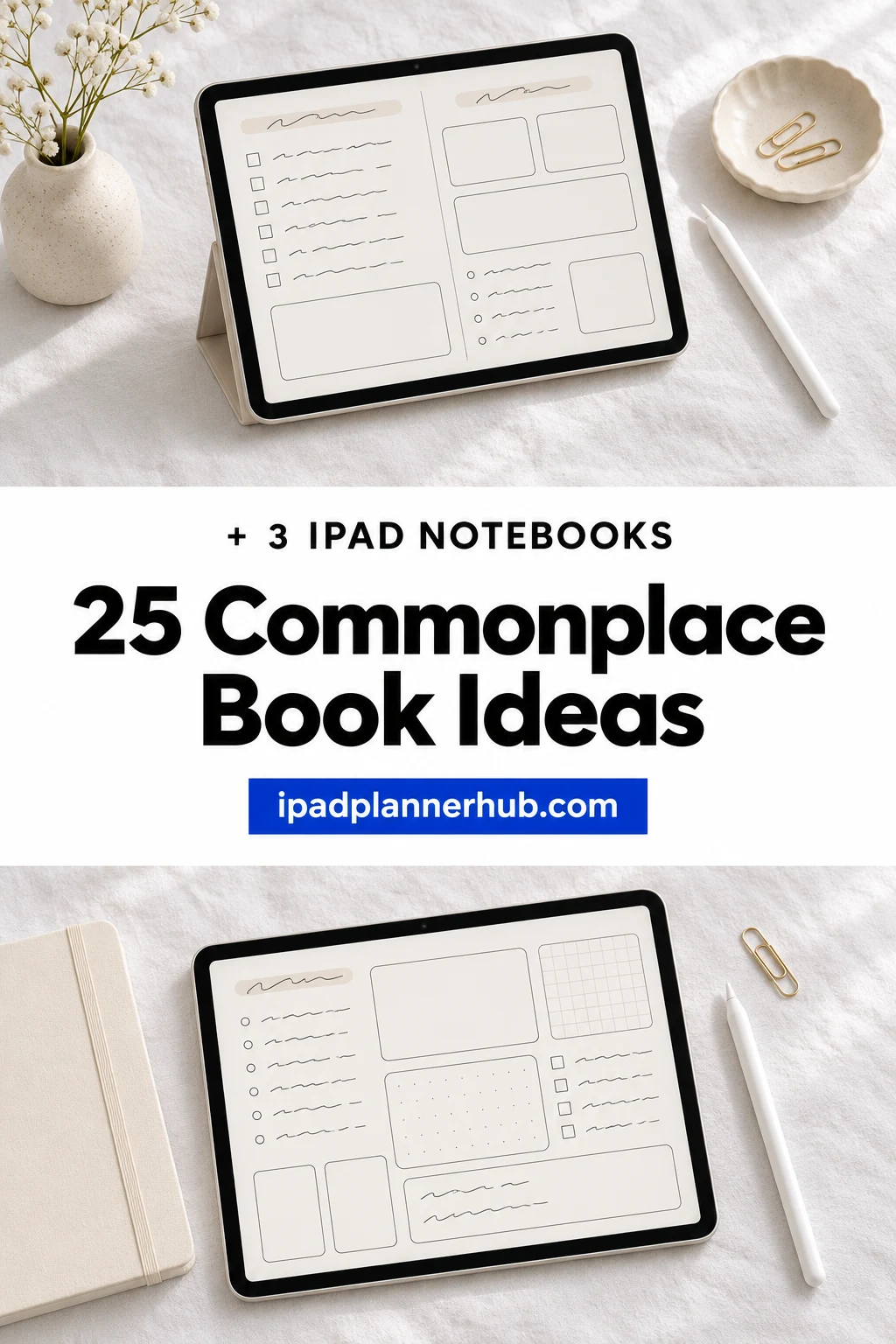
A commonplace book gathers ideas from reading, listening and observation alongside your own responses. It can hold several subjects without becoming a daily diary. I prefer a small entry with a retrievable source over an impressive page of unattributed quotations. On an iPad, a lined page, a two-column page or an empty canvas can all work; the organization comes from the labels you add.
If collecting sourced ideas is not the job you need from that notebook, these empty notebook ideas compare other useful purposes. Choosing the purpose first makes it easier to decide whether a commonplace book deserves its own space.
For observations from a walk, keep the place and visible detail beside your interpretation. These nature journal ideas develop that distinction through sketches, dated observations and questions to revisit at the same spot.
Listening notes can preserve a source and a response just as reading notes do. For recordings, these music journal ideas use the artist, recording version and a specific sound as reference points, with your own reaction kept distinct from what you heard.
Choose a Starting Point for These Commonplace Book Ideas
Begin with one question you actually care about, such as why certain explanations are easier to understand. Give each note a short title and an identifier, perhaps C01, then record the source and your response separately. The 25 options below are page recipes to borrow selectively. Start with a source card and one comparison; you do not need 25 new sections or a daily writing target.
If a source card leaves you with a question for your reading group, carry the passage locator into your meeting notes. These book club journal ideas show how to prepare discussion questions and preserve contrasting interpretations without replacing your personal response.
Capture the Source and Your First Response
- 1Source card
Put the title, author, publication date and page number or timestamp at the top. Under those details, summarize one idea in your own words and explain why you kept it. For an essay about library design, your note might be that seating arrangement changes how people use a room.
Add the exact web address if applicable. A title alone may be hard to locate later, and a saved link alone will not remind you what caught your attention.
- 2Quote with a response
Divide a page into a brief quotation and a separate response. Use quotation marks for the original wording, identify its source, then write whether you agree, disagree or need more context. For example, a short passage about simplicity might prompt a note that removing controls can also hide useful choices.
Keep your response longer than the quotation when possible. This preserves the distinction between a writer’s claim and the meaning you are building around it.
- 3Useful definition
Write a term, a plain-language definition and one concrete example. If the term is opportunity cost, describe the alternative you give up when choosing a weekend workshop over another activity. Leave space for a confusing case beneath the example.
Add the source used for the definition, especially when a word has a technical meaning. This page earns its place when you can explain the term without simply repeating the sentence you copied from a reference.
- 4Two competing views
Place one question at the top and give each source its own column. Suppose one writer favors tightly scheduled days while another favors open time: record their reasons, assumptions and intended audience. End with a sentence about where their advice actually differs.
They may be solving different problems rather than contradicting each other. Keep the source details beside each position so that a memorable argument never becomes detached from the conditions that made it reasonable.
- 5Question trail
Use three headings: starting question, provisional answer and next question. After reading about urban trees, you might move from why streets feel cooler to how shade differs from other cooling effects. Note which source answered which part, and leave unresolved details visible.
This format suits curiosity that changes direction as you read. Stop after one useful turn instead of trying to finish an entire subject; the next question becomes an invitation for another reading session.
Give Scattered Notes a Route Back
- 6An idea applied
Pair a borrowed idea with a specific place to try it. A discussion of clear instructions might become a plan to rewrite the first paragraph of a club invitation. Record the source, proposed change and what you would look for afterward.
Reserve a small result box rather than declaring the idea successful in advance. The point is to translate a general principle into a limited action, then keep enough context to judge whether the translation helped.
- 7Theme index
Create a manually maintained list of subjects and the identifiers of relevant entries. Under explanation, for instance, list C03 definitions, C11 arguments and C15 teaching notes, with a few words describing each. An entry can appear under more than one subject.
Review the index when you add a substantial note, rather than redesigning the whole notebook whenever a new interest appears. Page numbers or stable entry titles work even when you do not create any clickable links.
- 8Source register
Keep a register of books, articles, talks and other material you have actually consulted. Add creator, title, location and a one-line note about usefulness: helpful examples, uncertain evidence or a clear introduction. Separate finished sources from things you merely want to read.
A small status mark is enough. When several entries draw on the same book, the register lets you find its full details without turning every page into a bibliography or mistaking a recommendation for reading completed.
- 9Cross-reference map
Draw a few boxes for existing entries and label the connections between them. A note on museum captions might connect to one on classroom instructions because both depend on what the reader already knows. Write that reason on the connecting line.
Avoid a web made entirely of unlabeled arrows, which looks connected without explaining anything. Include entry identifiers in the boxes and limit the first map to three or four notes so you can inspect each relationship closely.
- 10Observation versus interpretation
Split the page into what happened and what you think it means. You might observe that three people paused at a confusing sign, then hypothesize that its arrow was ambiguous. Record the setting and what else could explain the pause.
This is a thinking aid, not a controlled experiment, so do not treat a casual observation as proof. The separation becomes especially useful when you revisit a confident first impression and discover that you recorded much less than you assumed.
Test What an Idea Can Explain
- 11Argument outline
Reduce an argument to its main claim, supporting reasons and unresolved questions. For an article favoring public benches, distinguish the claim about accessibility from examples about particular parks. Note whether a reason is evidence, an illustration or an assumption.
Add one question you would ask the author. The resulting page should make the reasoning easier to inspect; it should not make every argument sound stronger by removing qualifications, exceptions or uncertainty that mattered in the original.
- 12Example collection
Collect examples of one concept from different settings. A page about feedback might include a revised recipe, a teacher’s comment and a software error message. Explain how each example fits and where the comparison becomes imperfect.
Give every borrowed example its own source line; label invented examples as hypothetical. Three examples with explanations are more useful than a long list of names, because you can see whether the concept travels well beyond the first context where you encountered it.
- 13Counterexample page
Write a rule you are tempted to treat as universal, then keep a case that complicates it. If the rule is that shorter instructions are clearer, consider a short instruction that omits a necessary step. Describe what the counterexample changes: perhaps the better rule is to remove unnecessary words while preserving needed information.
This page is for refining a claim, not scoring points against an author. Revisit the original context before deciding that an exception overturns the whole argument.
- 14Changed-my-mind note
Save your earlier view, the new information and the revised view in distinct boxes. For example, a preference for completely unstructured notes might soften after you struggle to locate a useful source. Date the revision and identify what prompted it.
Preserve the original wording rather than quietly editing it to sound wiser. A changed position is most informative when you can see exactly which part shifted and which parts still seem sound after considering the new evidence.
- 15Personal explanation
Explain an idea as though a curious friend asked about it over coffee. Use a concrete starting point, define unfamiliar words and add one example the friend could picture. Then underline the sentence where your explanation becomes vague.
A note about attention might work better with a crowded train platform than with another abstract definition. Check the explanation against the source afterward. Writing simply can expose a gap, but simplicity by itself does not guarantee that your account is accurate.
Draw Connections Without Losing Nuance
- 16Small diagram
Sketch a process, relationship or sequence in your own arrangement. A diagram about publishing a club newsletter could show drafting, checking and circulation, with an arrow returning corrections to the next draft. Add a caption explaining what the diagram leaves out.
Record any source that informed it, and distinguish your own interpretation from the original model. A small labeled sketch beside a paragraph is often enough; visual complexity should not make a tentative connection look like an established system.
- 17Useful analogy
Keep an analogy together with its breaking point. You might compare a notebook index to a library catalog because both help locate material, then note that a personal index is selective and informal. Describe what the comparison helps explain before listing its limits.
This makes the page usable when you later explain the idea to someone else. Without the boundary, an analogy can quietly become an argument for similarities you never examined and that the original comparison cannot support.
- 18Curiosity queue
Give unanswered questions somewhere to wait without becoming tasks. Record the question, what sparked it and a possible starting source. For example, why do some building entrances feel easier to find than others?
Add a related entry identifier if you already have a note nearby. Leave deadlines out unless the question belongs to an actual project. When your reading energy is low, choose one question from the queue rather than opening another pile of unrelated tabs.
- 19Topic summary
Bring several notes on a single subject onto one summary page. Use a short statement of the current picture, two points of agreement and one unresolved disagreement. Reference the original entries instead of copying every passage again.
For a topic such as clear public information, the summary might combine notes about signs, maps and instructions. Label it provisional and date it. A summary should reveal what you understand now, while keeping a path back to material that might challenge it.
- 20Terms to distinguish
Write two easily confused terms side by side, then give each a definition and an example. Correlation and causation, for instance, need different claims about a relationship. Include a borderline case that forces you to decide which term applies.
Use a reliable subject reference when a distinction is technical. This page differs from a glossary because its purpose is the comparison: finish with a sentence describing the mistake you want to avoid when using the terms in your own writing.
Revisit, Revise and Make Something New
- 21Conversation insight
Capture a useful idea from a conversation without turning the page into a record of someone else’s private life. Note the topic and your understanding, and ask before preserving an identifiable quotation. A discussion about group meetings might suggest sending the question before the agenda.
Separate the other person’s suggestion from the action you infer from it. Names and personal details are usually unnecessary for this purpose; keep the transferable insight and enough context to understand why it mattered.
- 22Monthly rediscovery
Reopen three older entries and give each a fresh sentence: still useful, newly connected or no longer convincing. Pick notes that relate to something on your mind, rather than assuming you must review the whole notebook monthly. An old explanation of audience might now clarify a difficult email.
Add today’s date beside the response and leave the earlier note intact. This page turns review into active thinking, while making it acceptable for some saved ideas to remain interesting without becoming practical.
- 23Ideas worth trying
Select one note that suggests a manageable experiment. Record the idea, the situation, one change and the result you intend to notice. For example, compare two versions of a meeting invitation to see which leaves fewer unanswered questions.
Do not promise that the result will generalize beyond that situation. Afterward, write what happened and what remains uncertain. Return to the application you planned in idea 6. Record the result beside that plan or reference its entry identifier, so this page closes the loop instead of becoming a second list of intentions.
- 24Retired idea
Mark an idea as retired when it repeatedly fails to help or rests on a mistaken assumption. Record the old claim, why you are setting it aside and what you use instead, if anything. A complicated tagging scheme might be retired because you spend more time classifying notes than finding them.
Keep a reference to the old entry so future you understands the change. Retirement does not require a dramatic reversal; sometimes a method simply stops fitting your needs.
- 25One-page synthesis
End a small reading sequence with one page that makes a claim of your own. Put the central thought at the top, cite the entries supporting it and acknowledge the strongest unresolved question. For example, your notes might suggest that useful instructions depend more on anticipated questions than on brevity alone.
Add where you could use this synthesis, such as a short essay or a revised guide. This is the move from collecting other people’s ideas to constructing something you can explain.
Match Your Notes to a Page Layout
Match the page to the kind of thinking. Lined paper suits a personal explanation or a reading response. Two columns help separate a source from your interpretation. Dot grid or blank space gives diagrams room to grow. For a mixed notebook, use subjects as section labels and entry identifiers inside each section. For a chronological journal, maintain a separate subject index so dates do not become your only route back.
If a reading question becomes a student investigation, keep the source note connected to a separate session record. These student research journal layouts give methods, observations and file references their own place, so a collected idea does not stand in for evidence of what you did.
Before choosing a new notebook, make one source card on a page you already own. Check whether there is room for the citation and your response without shrinking your handwriting. I would only change the template if its layout solves a repeated problem, such as needing distinct columns or longer writing space. The three options below are alternatives; one suitable notebook is enough, and none supplies a complete commonplace system for you.
Three Notebooks for Different Ways of Keeping Ideas
TL;DR: Three alternatives for your commonplace notes: a sectioned notebook for comparisons, a small decorated journal for brief entries, or ruled pages for writing in sequence. Add your own sources and subject index.
Quick Picks
- Best for subject sections: Digital Notebook
- Best for short idea cards: Undated Cute Orange Bullet Journal
- Best for notes in sequence: Digital Ruled Journal
- Digital Notebook – Best for subject sections
- Undated Cute Orange Bullet Journal – Best for short idea cards
- Digital Ruled Journal – Best for notes in sequence
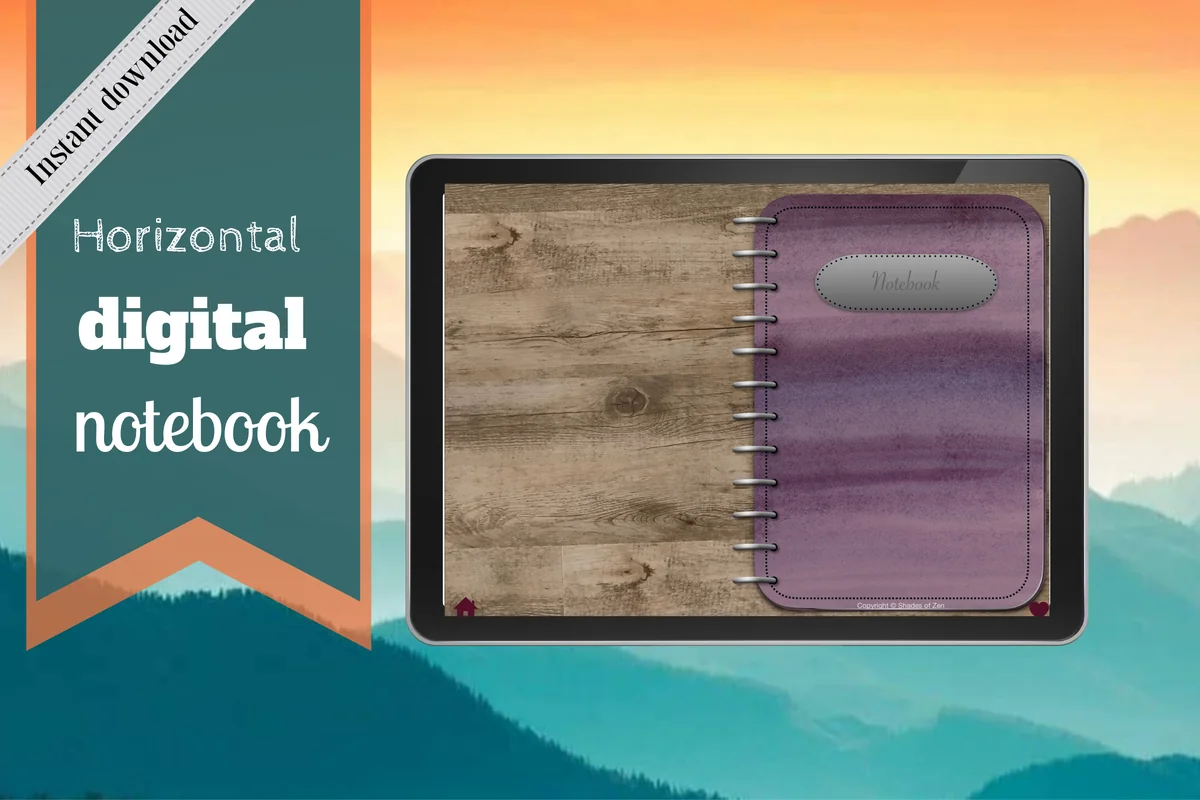
Best for subject sections
1. Digital Notebook
Orientation: LandscapeLayouts: 16 note templates; 12 sections
Best for: keeping sources and responses in separate columns. Designed by Shades of Zen.
- 12 sections with individual dividers
- 16 note templates, including lined, dot grid, two-column and Cornell options
- GoodNotes and PDF annotation apps named in the description
- Linked section tabs described and pictured
The two-column template is the most relevant detail here: a source can sit on one side while your response stays visibly separate. I like the section structure for a few recurring subjects, with a manual entry index inside each. These are general note pages, so you add your own citation headings and cross-references. Choose it for page variety rather than a ready-made commonplace workflow.
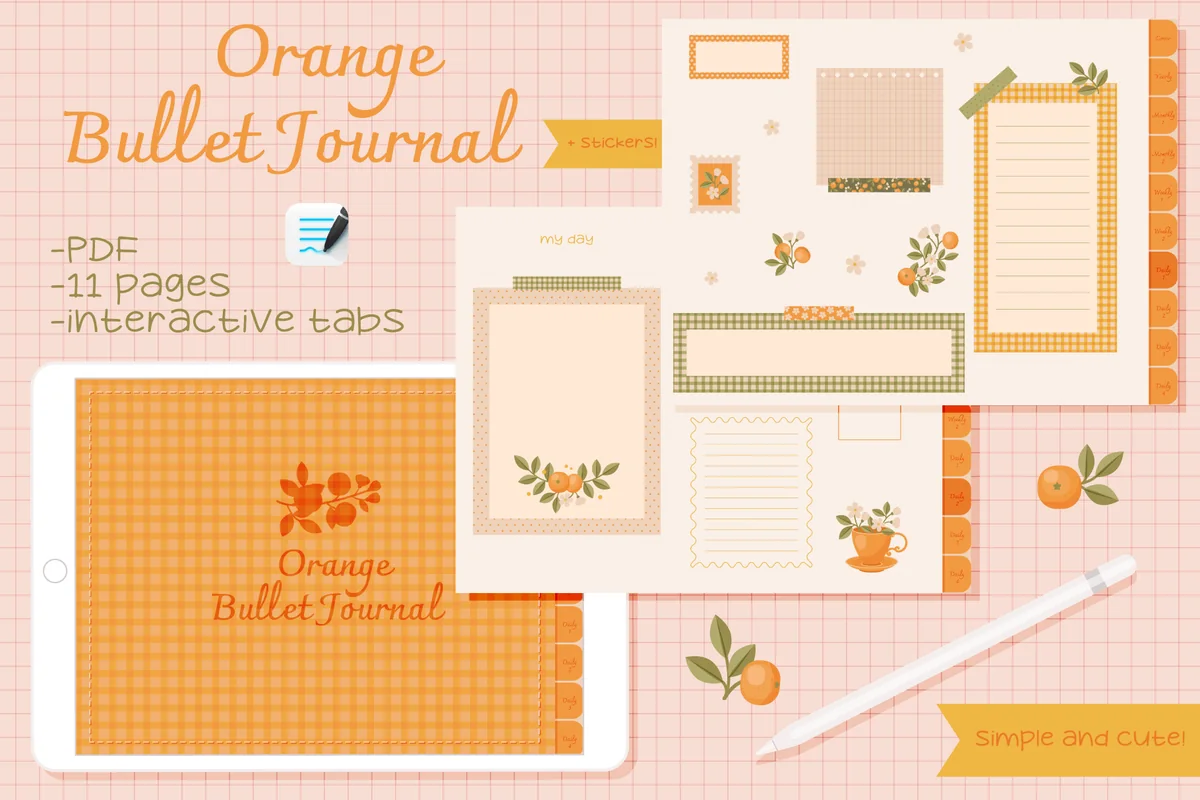
Best for short idea cards
2. Undated Cute Orange Bullet Journal
Layouts: Fill-in calendar and decorated writing framesDates: Undated
Best for: brief source notes in decorated frames. Designed by digitaliya_studio.
- PDF journal with a GoodNotes import workflow
- Unfilled calendar and decorated note frames shown
- Stickers supplied in GoodNotes format
- Orange, cream and green design across the pictured pages
Short entries suit the small frames better than long quotations or extended arguments. A frame could hold one idea and its source, while the fill-in calendar can remind you to revisit a reading question. The decoration takes up writing space, which is a real trade-off if your notes tend to expand. This is a visual alternative for concise notes, not a specialist commonplace template or a reason to replace a blank notebook that already works.
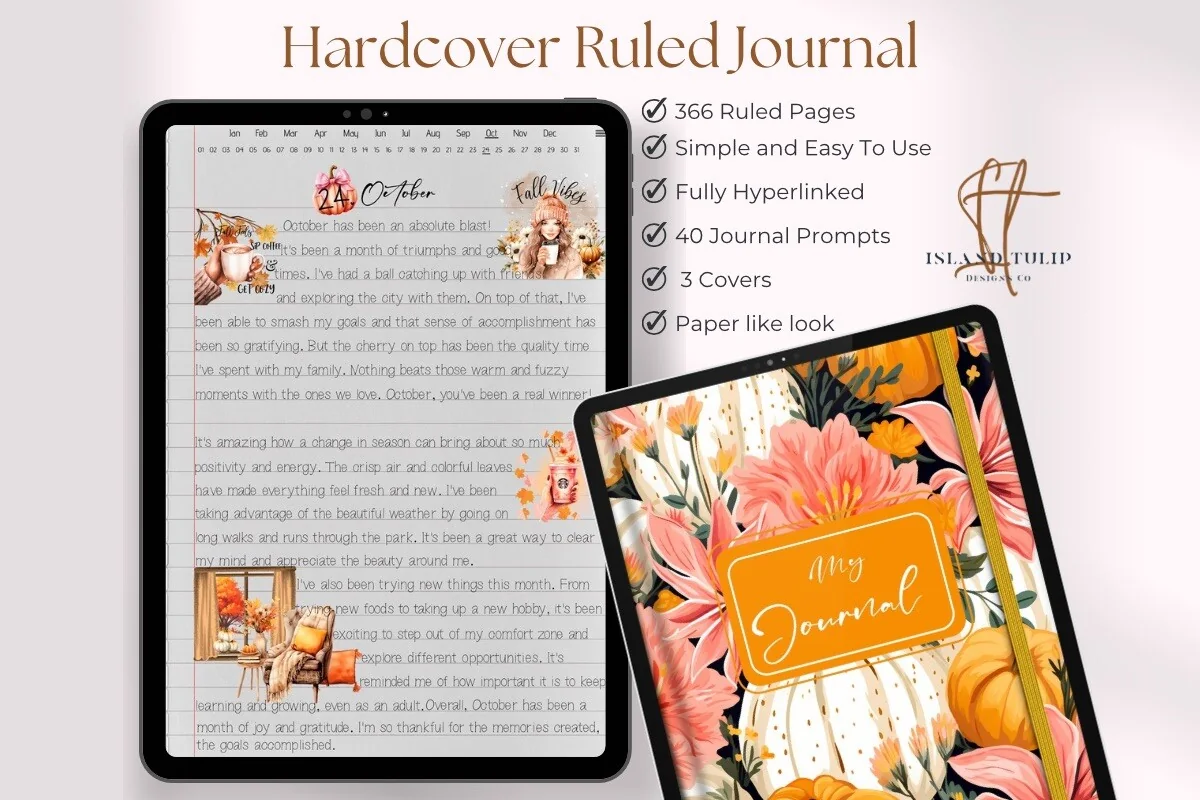
Best for notes in sequence
3. Digital Ruled Journal
Orientation: PortraitLayouts: 366 ruled pages; chronological index
Best for: longer reading responses organized by date. Designed by Island Tulip Designs Co.
- 366 ruled pages stated in the listing and cover
- Month and numbered-day navigation pictured
- Three covers shown
- 40 journal prompts with PNG and precropped GoodNotes versions stated
Choose this when you want to keep writing rather than switch between subject layouts. The ruled pages leave the structure to your sentences, and the pictured index follows months and numbered days. For commonplace use, add a separate topic list with entry titles so you can find a thought without remembering when you wrote it. The included general journal prompts are optional extras; they do not replace source tracking. Use the dated navigation for sequence, and your own index for subjects.
Quick Comparison
| Option | Structure | Useful for | Keep in mind |
|---|---|---|---|
| 1. Digital Notebook | Sectioned notebook | Columns and mixed notes | Create your own entry fields |
| 2. Undated Cute Orange Bullet Journal | Compact journal | Short entries and calendar | Limited writing space |
| 3. Digital Ruled Journal | Ruled journal | Extended prose | Separate subject index needed |
FAQ: Commonplace Book Ideas
How is a commonplace book different from a journal?
A commonplace book centers on ideas you encounter and the thinking they prompt. A journal can center on your experiences, feelings or daily events. There is room for overlap, but a source line and a response give a commonplace entry its particular purpose. If you want a broader personal practice, explore our digital journaling ideas.
Should I organize entries by subject or date?
Use subjects when you regularly return to the same questions. Use dates when writing in sequence helps you start. Either approach benefits from a short manual index. You can keep dated entries inside subject sections without creating an elaborate classification system before you have anything to classify.
Do I need to copy exact quotations?
No. A paraphrase with a clear source is often enough. When exact wording matters, keep the quotation brief, use quotation marks and put your own response beside it. Do not treat a paraphrase as an exact quote or remove qualifications that change the original meaning.
A phrase saved from reading in another language can become more than a quotation. These language learning journal ideas pair source context with your own sentences and checked corrections, giving the borrowed wording a separate place for practice.
Will a digital notebook create cross-references automatically?
Do not assume that it will. A PDF notebook may offer section navigation, while connections between individual entries remain your own work. Write stable entry titles or identifiers in the text. App-specific search, bookmarks or links depend on the app and document; they are not promised features of these page recipes.
For an idea captured from a podcast, the source reference and the listening status serve different jobs. Keep the longer response here, and use a podcast listening queue to record the paused episode, stopping point and reason to return.
Make the Next Note Easy to Find
Choose one question and capture one idea with its source today. Leave a small space for a later response instead of trying to settle everything at once. These commonplace book ideas become useful when a note changes what you notice, question or make. A notebook that helps you return to five worthwhile entries is already doing meaningful work.
You May Also Like
This article contains affiliate links. If you buy through them, I may earn a commission at no extra cost to you. Read the affiliate disclosure.